USAID DEC
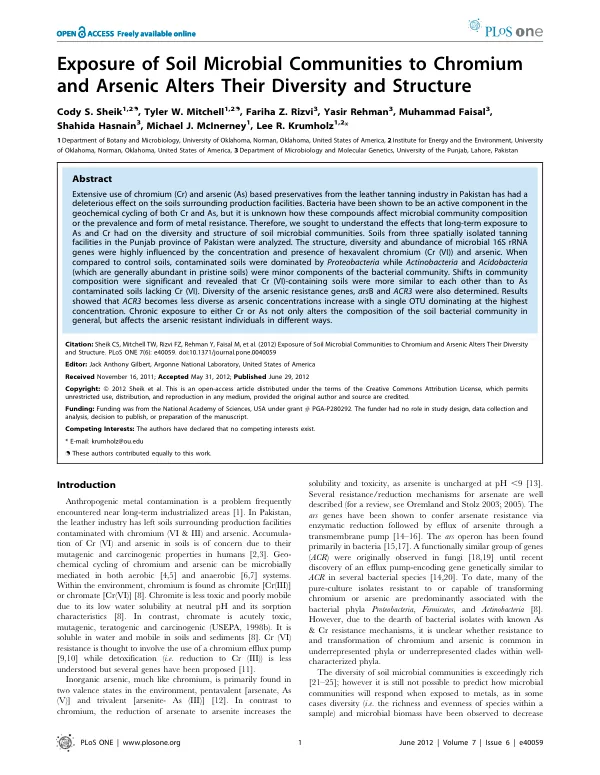
Exposure of Soil Microbial Communities to Chromium and Arsenic Alters Their Diversity and Structure
Sign inUSAID DEC
Exposure of Soil Microbial Communities to Chromium and Arsenic Alters Their Diversity and Structure
Soil microbial communities play a crucial role in geochemical cycling of metals such as chromium (Cr) and arsenic (As).
2012 · 13 pages
Sign in to readA free account is required to download.
Abstract
However, long-term exposure to these metals can have deleterious effects on the structure and function of these communities. In Pakistan, the leather industry has left soils surrounding production facilities contaminated with Cr(VI) and As. This contamination has raised concerns due to the mutagenic and carcinogenic properties of these metals in humans. The diversity of soil microbial communities is rich and complex, with various phyla such as Proteobacteria, Firmicutes, and Actinobacteria being associated with metal resistance. However, the effects of chronic exposure to metals on these communities are not well understood. A study conducted in the Punjab province of Pakistan aimed to investigate the effects of chronic chromium and arsenic contamination on soil bacterial communities from three spatially distant, long-term leather production areas. The study found that in the presence of metals, novel Proteobacteria were abundant community members. This suggests that Proteobacteria may be more tolerant to chromium and arsenic contamination than other phyla. The study also found that arsenic concentration dramatically influenced the diversity of arsenic resistance genes. Specifically, the diversity of the arsenic resistance genes, arsB and ACR3, was found to decrease as arsenic concentrations increased. The study used a paired sampling design, collecting control soil samples near contaminated sites and had similar soil properties. Soil was collected from each site in 0.1 m2 blocks using a sterile shovel, placed into gamma-sterilized polyethylene bags, transported on ice back to the laboratory, and stored at 220oC. Soil texture, chemistry, and metal analyses were performed by the Pakistan Council Scientific and Industrial Research (PCSIR). Metals were extracted using the microwave-assisted ISO 11466:1995 standard method, and total extractable chromium and arsenic were analyzed using inductively coupled plasma atomic emission spectroscopy (ICP-AES). The results of this study have important implications for understanding the effects of chronic metal contamination on soil microbial communities. The findings suggest that Proteobacteria may be more tolerant to chromium and arsenic contamination than other phyla, and that arsenic concentration can dramatically influence the diversity of arsenic resistance genes. This knowledge can be used to develop strategies for mitigating the effects of metal contamination on soil microbial communities and to improve our understanding of the complex interactions between metals and microorganisms in the environment. The study's findings also highlight the importance of considering the effects of chronic metal contamination on soil microbial communities in the context of long-term industrial activities. The leather industry in Pakistan has a longstanding history of contaminating soils with chromium and arsenic, and this contamination has had significant impacts on the local environment and human health. By understanding the effects of chronic metal contamination on soil microbial communities, we can better develop strategies for mitigating the impacts of industrial activities on the environment and human health. The study's methodology involved collecting soil samples from three spatially distant, long-term leather production areas in the Punjab province of Pakistan. The samples were collected using a paired sampling design, with control soil samples collected near contaminated sites and having similar soil properties. The soil samples were then analyzed for metal content, soil texture, and chemistry using various methods, including ICP-AES and particle size distribution. The results of the study provide valuable insights into the effects of chronic metal contamination on soil microbial communities and highlight the importance of considering the impacts of industrial activities on the environment and human health.
Related documents
Documents in this collection
 2017
2017USAID DEC
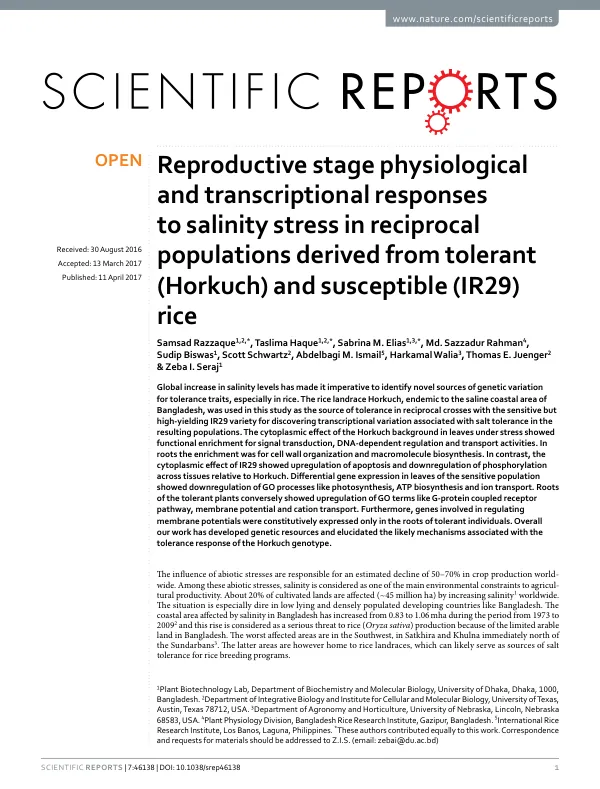
Reproductive stage physiological and transcriptional responses to salinity stress in reciprocal populations derived from tolerant (Horkuch) and susceptible (IR29) rice
Open record 2016
2016USAID DEC