USAID DEC
Is an integrated model of school eye health delivery more cost-effective than a vertical model? An implementation research in Zanzibar
Sign inUSAID DEC
Is an integrated model of school eye health delivery more cost-effective than a vertical model? An implementation research in Zanzibar
The integrated model of school eye health delivery was implemented in 19 rural schools in Zanzibar from April to October 2017.
2021 · 6 pages
Sign in to readA free account is required to download.
Abstract
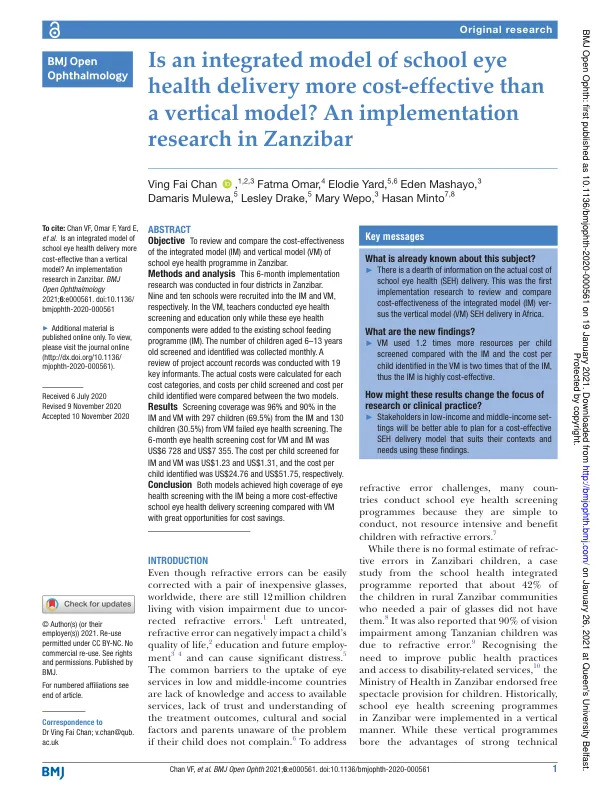
The research aimed to compare the cost-effectiveness of the integrated model (IM) with the vertical model (VM) of school eye health delivery. The IM was integrated with the existing school feeding programme, while the VM was a standalone programme. The study was conducted in four districts in Unguja and Pemba Island, with nine schools participating in the IM and 10 schools in the VM. The schools in the IM had an existing school feeding programme, while the schools in the VM did not. The research protocol was approved by the Zanzibar Medical Research and Ethics Committee, and community beneficiaries were involved in the development of the school eye programme through patient and public involvement meetings. The IM and VM were implemented in two phases. Phase 1 involved training six master trainers, who subsequently trained 60 teachers in vision screening, recording, and referral pathways, as well as delivering health education to children. The training for the IM was a 2-day session, while the training for the VM was a 1-day session. Phase 2 involved teachers conducting eye health screening from April to September 2017. In the VM, the schools received only the eye health intervention, while in the IM, the eye health intervention was integrated with the school feeding programme. The results of the study showed that the IM achieved a higher screening coverage of 96% compared to the VM, which achieved a screening coverage of 90%. The IM also identified 297 children with eye conditions, while the VM identified 130 children. The 6-month eye health screening cost for the VM was US$6,728, while the cost for the IM was US$7,355. The cost per child screened for the IM was US$1.23, while the cost per child screened for the VM was US$1.31. The cost per child identified for the IM was US$24.76, while the cost per child identified for the VM was US$51.75. The study concluded that the IM was a more cost-effective school eye health delivery model compared to the VM, with great opportunities for cost savings. The findings of the study suggest that integrating school eye health with existing school feeding programmes can be a cost-effective way to deliver eye health services to children in low-income settings. The study's results can inform the development of cost-effective school eye health delivery models in other low-income settings.