INTRAHEALTH
ISS-CHW Programming-Year 2 Annual Report-May 2018
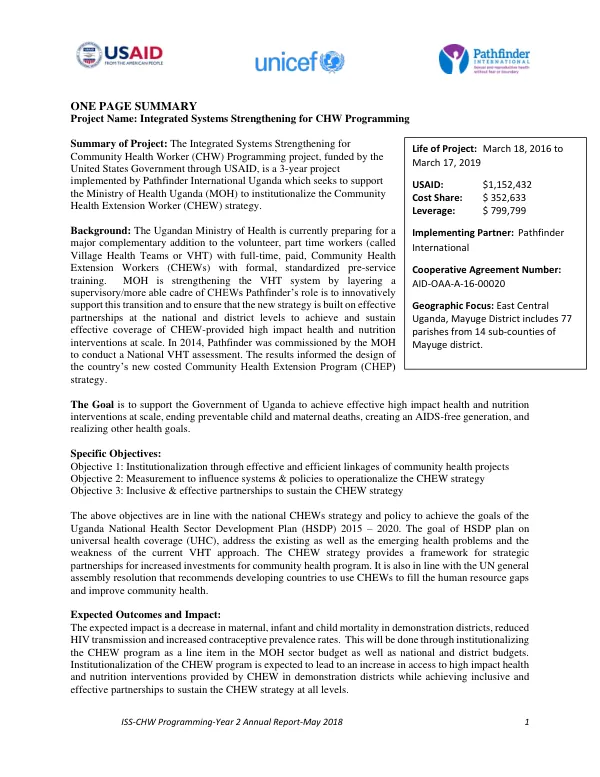
The Integrated Systems Strengthening for Community Health Worker (CHW) Programming project is a 3-year initiative implemented by Pathfinder International Uganda, with funding from the United States Government through USAID.
2018 · 11 pages
Sign in to readA free account is required to download.
Abstract
The project aims to support the Ministry of Health Uganda (MOH) in institutionalizing the Community Health Extension Worker (CHEW) strategy. The CHEW strategy seeks to strengthen the Village Health Teams (VHT) system by layering a supervisory/more able cadre of CHEWs with formal, standardized pre-service training. The project's goal is to support the Government of Uganda in achieving effective high-impact health and nutrition interventions at scale, ending preventable child and maternal deaths, creating an AIDS-free generation, and realizing other health goals. The specific objectives of the project are to institutionalize the CHEW program through effective and efficient linkages of community health projects, to measure and influence systems and policies to operationalize the CHEW strategy, and to establish inclusive and effective partnerships to sustain the CHEW strategy. The project has made significant progress in year two, including the completion of CHEW training materials and operational guidelines, the sensitization and selection of CHEWs from 13 pilot districts, and the readiness study conducted to identify systems gaps. The project has also strengthened partnerships through National CHEW Coordination Committee (NCCC) meetings and coordination meetings with implementing partners. However, the project has faced several challenges, including governance issues within MOH, capacity constraints in districts, and donor financing constraints. The project will continue to engage stakeholders to address these challenges, including advocating for the issuance of a letter of clearance, identifying resources for CHEW training, and strengthening the MOH structure to support CHEW activities. The project has achieved several key milestones, including the completion of CHEW training materials and operational guidelines, the sensitization and selection of CHEWs from 13 pilot districts, and the readiness study conducted to identify systems gaps. The project has also strengthened partnerships through NCCC meetings and coordination meetings with implementing partners. The project's geographic focus is East Central Uganda, with a specific focus on Mayuge District, which includes 77 parishes from 14 sub-counties. The project has a budget of $1,152,432, with a cost share of $352,633 and leverage of $799,799. The project's implementing partner is Pathfinder International, and the cooperative agreement number is AID-OAA-A-16-00020. The project's expected outcomes and impact include a decrease in maternal, infant, and child mortality in demonstration districts, reduced HIV transmission, and increased contraceptive prevalence rates. The project aims to institutionalize the CHEW program as a line item in the MOH sector budget and national and district budgets, leading to an increase in access to high-impact health and nutrition interventions provided by CHEWs in demonstration districts.