MINISTRY OF AGRICULTURE
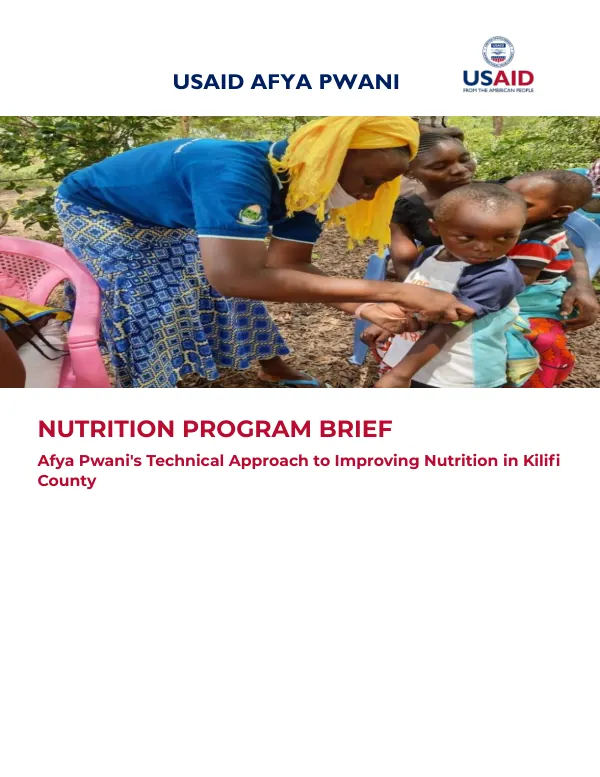
USAID Afya Pwani Nutrition Program Brief
The USAID Afya Pwani Nutrition Program aimed to improve nutrition outcomes in Kilifi County, Kenya.
2021 · 6 pages
Sign in to readA free account is required to download.
Abstract
The program was implemented from 2016 to 2021 and focused on enhancing access to and use of quality health services, particularly in the areas of maternal, infant, and young child nutrition (MIYCN). Kilifi County is characterized by high rates of stunting, food insecurity, and malnutrition, with a stunting rate of 39.1% at baseline. The program's technical approach was guided by the UNICEF conceptual framework, which identifies the causes of malnutrition. Afya Pwani worked closely with the Kilifi County Department of Health (DOH) to strengthen its capacity to offer quality MIYCN services and reduce malnutrition among children between 0 and 59 months. The program supported the county in implementing targeted nutrition interventions across seven sub-counties, focusing on 174 health facilities. Afya Pwani enhanced and sustained coordination mechanisms and capacity to offer quality nutrition services at the county, sub-county, health facility, and community levels. The program supported the county in equipping healthcare providers with knowledge and skills on high-impact nutrition interventions (HINI) through training, mentorship sessions, continuous medical education (CME), and supportive supervision. The project also procured and distributed anthropometric equipment and protocols for quality nutrition services at the facility level. The program improved community knowledge, attitude, and practice on maternal, infant, and young child feeding. Afya Pwani provided continuous mentorship and coaching to community health volunteers (CHVs) on monitoring growth, categorizing the child, and documentation to ensure strengthened linkages at the community level and improved behavior change by caregivers. The project also facilitated training on growth monitoring, PD Hearth, MIYCN, and BFCI for CHVs. Afya Pwani supported the DOH to implement the Baby-Friendly Community Initiative (BFCI) to strengthen maternal nutrition practices for pregnant and lactating women and complementary feeding for children ages 6 to 23 months. The project also enhanced the community's capacity to prevent, identify, and treat malnutrition using locally available resources, training CHVs to monitor the trends in malnutrition per ward, conduct rapid assessment where necessary, and implement hearth sessions to treat malnutrition. The program improved household food security and nutrition initiatives in target communities. Afya Pwani facilitated linkages between the Ministry of Health (MOH) and the Ministry of Agriculture (MoA) to establish kitchen gardens in health facilities and communities to improve food security at the household level. The project supported the establishment of demonstration gardens in 355 health facilities and 166 community gardens to aid practical sessions. The program achieved several key outcomes, including improved Vitamin A and iron/folate supplement (IFAS) coverage, supported the development and launch of the second generation County Nutrition Action Plan (CNAP), and advocated for inclusion of a budget line for nutrition in the county health budget. The program also improved capacity to offer quality services on integrated management of acute malnutrition and strengthened the quality of routine data, the use of data for decision-making, and the implementation of multisector activities such as planning and implementing Malezi Bora days.