U.S. DEPARTMENT OF STATE/OES
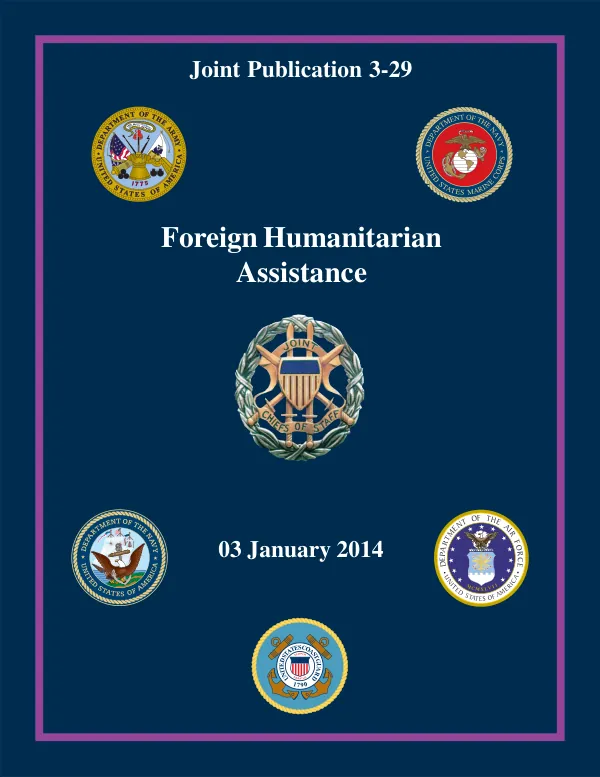
Joint Publication 3-29: Foreign Humanitarian Assistance
Foreign Humanitarian Assistance Joint Publication 3-29 provides joint doctrine for planning, executing, and assessing foreign humanitarian assistance operations.
2014 · 203 pages
Sign in to readA free account is required to download.
Abstract
This publication has been prepared under the direction of the Chairman of the Joint Chiefs of Staff and sets forth joint doctrine to govern the activities and performance of the Armed Forces of the United States in joint operations. It provides military guidance for the exercise of authority by combatant commanders and other joint force commanders, and prescribes joint doctrine for operations, education, and training. The publication redefines foreign humanitarian assistance as an "umbrella" term over associated humanitarian type activities, including foreign disaster relief. It establishes foreign consequence management as a related, but separate activity that may require foreign humanitarian assistance support. The publication also establishes the proper sequence and presentation of information by moving the planning and execution processes into the correct order. The Joint Publication 3-29 applies to the joint staff, commanders of combatant commands, subunified commands, joint task forces, subordinate components of these commands, the Services, and combat support agencies. The guidance in this publication is authoritative, and as such, it will be followed except when, in the judgment of the commander, exceptional circumstances dictate otherwise. The publication provides an overview of foreign humanitarian assistance, including legal authority and policy, operational environment, types of foreign humanitarian assistance and supported missions and activities, related operations, operational context, crisis response and limited contingency operations, mission transition termination, and funding. It also discusses organization and interagency coordination, including the United States Government civilian departments and agencies, Department of Defense, key non-United States Government participants and organizations, nongovernmental organizations, intergovernmental organizations, and private sector partners. The publication emphasizes the importance of planning, execution, and assessment in foreign humanitarian assistance operations. It discusses the deployment, sustainment, command and control, assessment, intelligence, information sharing, protection, engineer operations, rules of engagement, legal considerations, liaison, communication synchronization, public affairs, dislocated civilians, and health and medical support. The Joint Publication 3-29 provides a comprehensive framework for foreign humanitarian assistance operations, emphasizing the importance of interagency coordination, planning, and execution. It serves as a guide for military commanders and other stakeholders involved in foreign humanitarian assistance operations, providing a clear understanding of the operational environment, types of assistance, and related operations. The publication highlights the need for a coordinated approach to foreign humanitarian assistance, involving multiple stakeholders, including the Department of Defense, Department of State, United States Agency for International Development, and nongovernmental organizations. It emphasizes the importance of understanding the operational environment, including the legal authority and policy, operational context, and crisis response and limited contingency operations.