USAID DEC
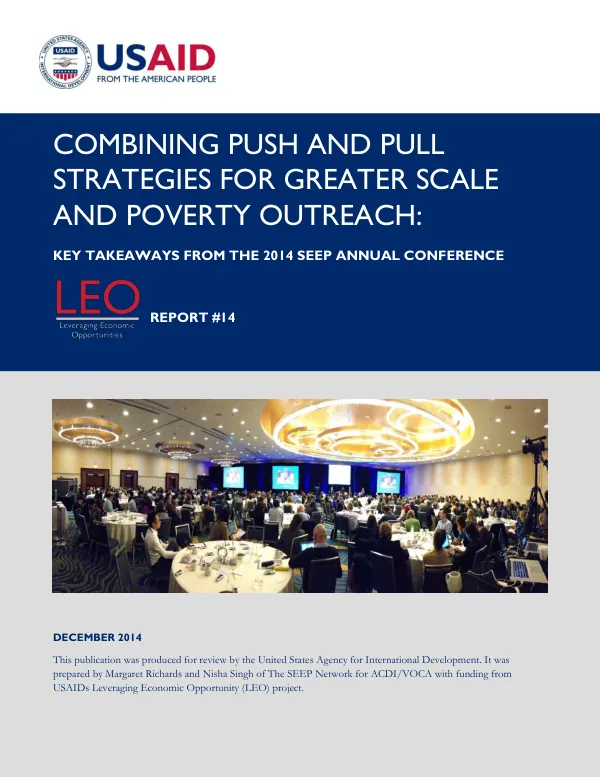
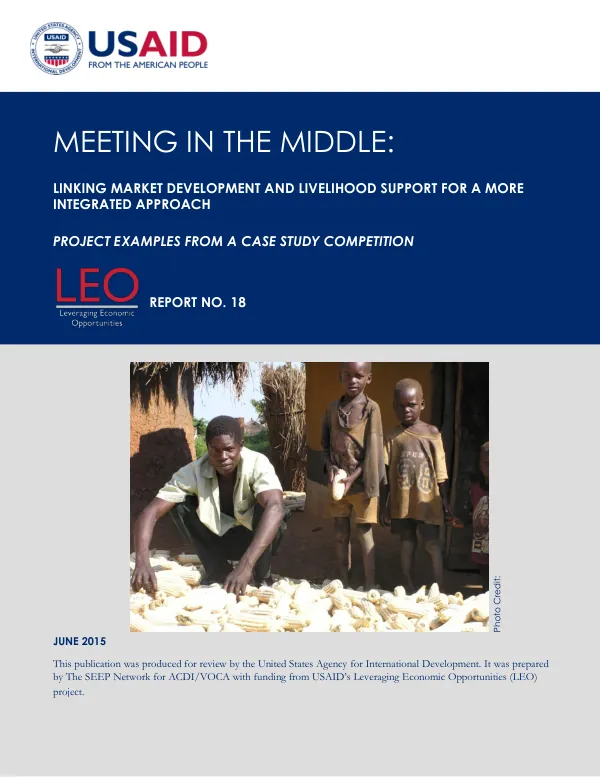
Jumpstarting Agribusiness Markets: Meeting in the Middle: Linking Market Development and Livelihood Support for a More Integrated Approach
Sign inACDI/VOCA
Jumpstarting Agribusiness Markets: Meeting in the Middle: Linking Market Development and Livelihood Support for a More Integrated Approach
The Leveraging Economic Opportunities (LEO) project launched a call for examples in March 2014, seeking programs that linked push and pull strategies into a more interactive implementation framework.
2015 · 34 pages
Sign in to readA free account is required to download.
Abstract
The collective understanding of push/pull was still evolving, and the open call for examples aimed to help get a sense of the state of practice, canvas experiences from a wide range of projects, and inform how LEO prioritized its work in this area. Of 53 submissions received, 33 were determined relevant for LEO's specific learning agenda and were reviewed by a committee of representatives from USAID, LEO, the SEEP Network, and the MaFI and STEP UP working groups. Nine cases were selected for further exploration, four of which are presented in this document. The cases were selected based on their relevance to LEO's learning agenda and their potential to inform the development of a framework paper on the push/pull approach. The push/pull approach sequences and layers push strategies to build the capacities of the extreme poor to engage in markets, and pull strategies to expand the diversity and quality of economic opportunities accessible to the extreme poor. The push strategies include interventions to build household or community assets, improve links to social protection, build market readiness skills, and strengthen household capacity to manage risk. The pull strategies include interventions to lower barriers to market entry, extend services, improve working conditions, and strengthen market demand for products that can be supplied by the poor. The cases in the call for examples demonstrate both the strengths and the challenges of the push/pull approach, highlighting the need for a more integrated approach that combines push and pull strategies. The SAK REP project in Haiti is one of the cases presented in this document. The project was a $100 million Multi-Year Assistance Program (MYAP) operated by World Vision from 2008-2013. The project aimed to improve the food security and resilience of vulnerable Haitian households by adopting a market-sensitive strategy. The approach helped households meet their immediate daily needs while strengthening their ability to increase and improve crops for improved self-sustenance and sales to local and export markets. The project's success was attributed to its ability to sequence and layer push and pull strategies, building the capacities of households to engage in markets and expanding the diversity and quality of economic opportunities accessible to them. The project's theory of change was critical in informing the design and implementation of the push/pull approach, and the use of sequencing, phasing, and layering of interventions was key to incrementally link together push and pull strategic efforts. The SAK REP project's experience highlights the importance of thinking through the how, when, where, and why push and pull will interact, along with the "who" in order to drive change and ensure harmonization with the theory of change. The project's success also underscores the need for a robust theory of change when applying an integrated push/pull approach.