ACTED
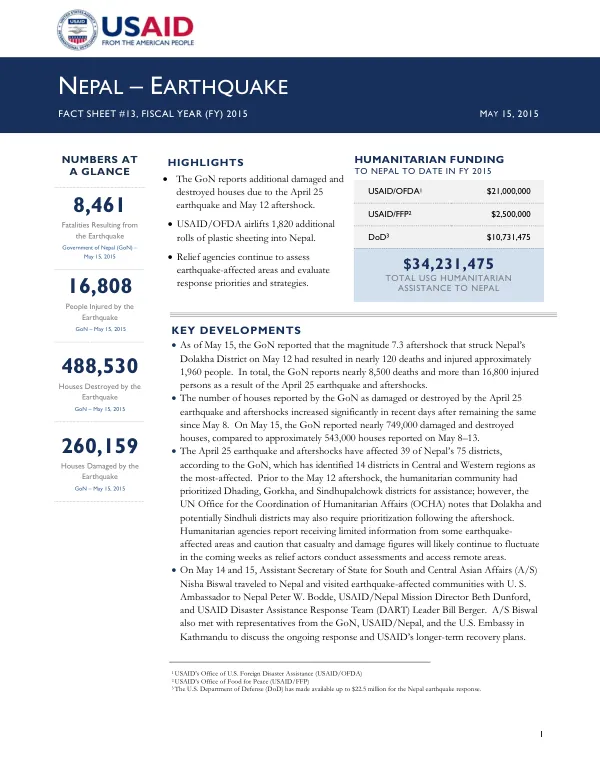
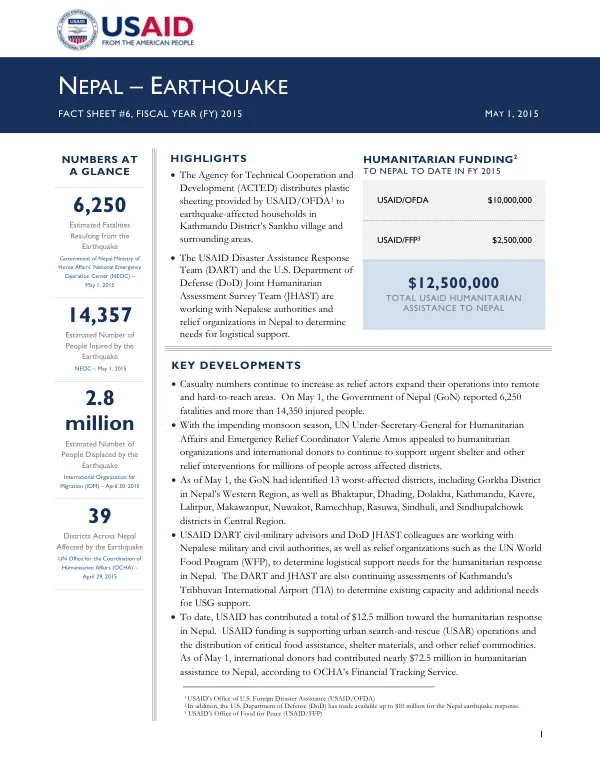
Nepal – Earthquake Fact Sheet #6, Fiscal Year (FY) 2015
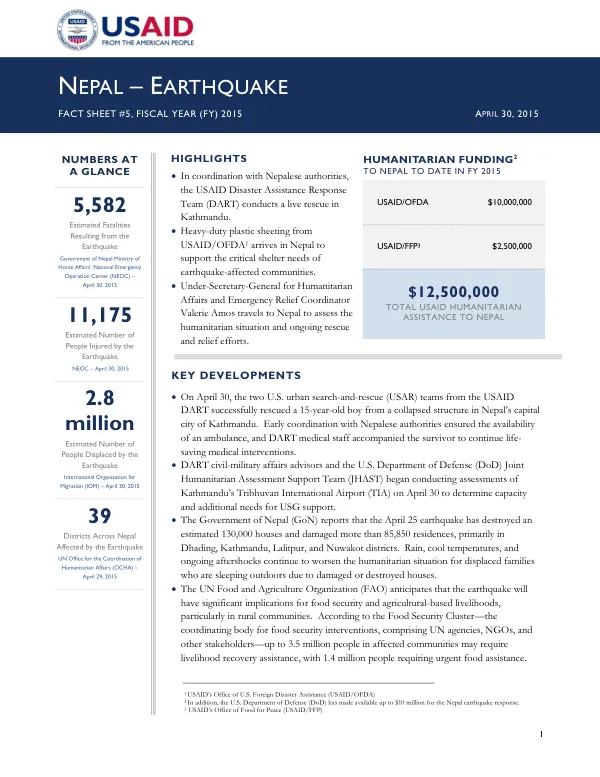
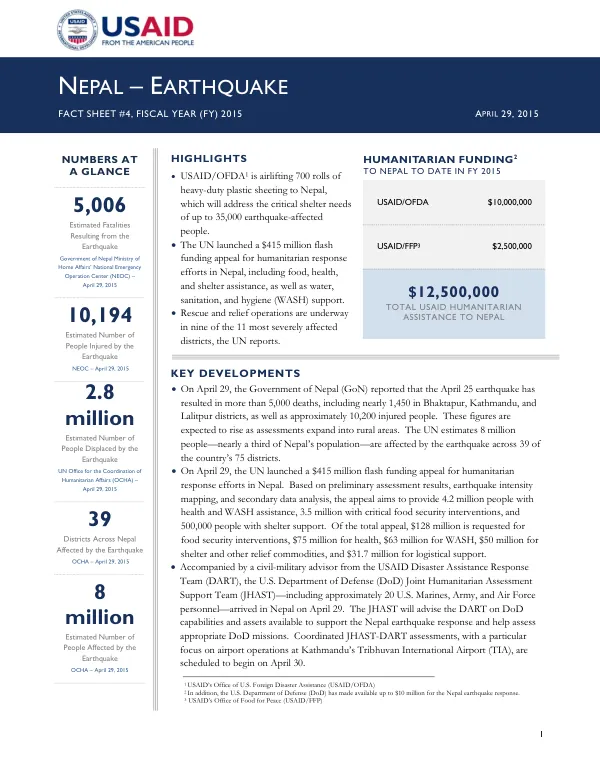
The Government of Nepal reported 6,250 fatalities and more than 14,350 injured people as of May 1, 2015.
2015 · 6 pages
Sign in to readA free account is required to download.
Abstract
The Government of Nepal identified 13 worst-affected districts, including Gorkha District in Nepal's Western Region, as well as Bhaktapur, Dhading, Dolakha, Kathmandu, Kavre, Lalitpur, Makawanpur, Nuwakot, Ramechhap, Rasuwa, Sindhuli, and Sindhupalchowk districts in Central Region. The USAID Disaster Assistance Response Team (DART) and the U.S. Department of Defense (DoD) Joint Humanitarian Assessment Survey Team (JHAST) are working with Nepalese authorities and relief organizations in Nepal to determine needs for logistical support. The DART and JHAST are also continuing assessments of Kathmandu's Tribhuvan International Airport (TIA) to determine existing capacity and additional needs for USG support. To date, USAID has contributed a total of $12.5 million toward the humanitarian response in Nepal. USAID funding is supporting urban search-and-rescue (USAR) operations and the distribution of critical food assistance, shelter materials, and other relief commodities. As of May 1, international donors had contributed nearly $72.5 million in humanitarian assistance to Nepal, according to OCHA's Financial Tracking Service. The Agency for Technical Cooperation and Development (ACTED) distributes plastic sheeting provided by USAID/OFDA to earthquake-affected households in Kathmandu District's Sankhu village and surrounding areas. The USAID DART and the U.S. Department of Defense (DoD) Joint Humanitarian Assessment Survey Team (JHAST) are working with Nepalese authorities and relief organizations in Nepal to determine needs for logistical support. Current estimates indicate that the April 25 earthquake destroyed 160,786 houses and damaged an additional 143,357 residences, according to the Government of Nepal Ministry of Home Affairs' National Emergency Operation Center (NEOC). With the impending monsoon season, shelter support remains the most urgent need in affected communities, the UN reports. To date, humanitarian organizations have provided approximately 30,000 tarps, as well as blankets, solar lamps, and other supplies, to households in need. Plans to distribute another 80,000 tarps are underway. As of April 30, nearly 24,000 internally displaced persons (IDPs) continued to shelter in 13 Government of Nepal-identified open spaces—comprising public parks, recreational fields, schools, and other designated sites—in Bhaktapur, Kathmandu, and Lalitpur districts, according to IOM's displacement tracking matrix. While a number of actors, including the Government of Nepal, the private sector, and NGOs, have provided basic services to camp populations, service provision across the camps is uneven, IOM reports.
Related documents