THE INTERNATIONAL REPUBLICAN INSTITUTE
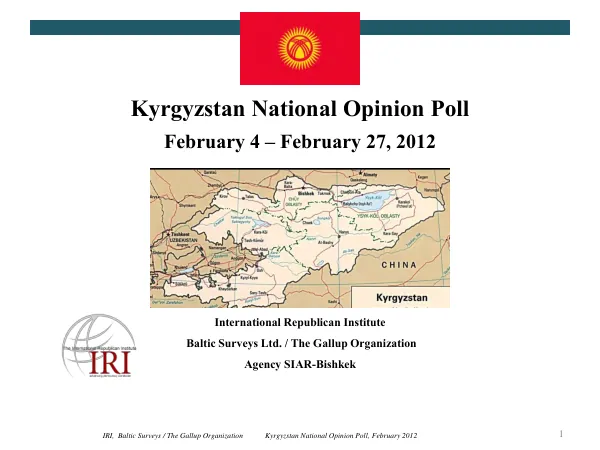
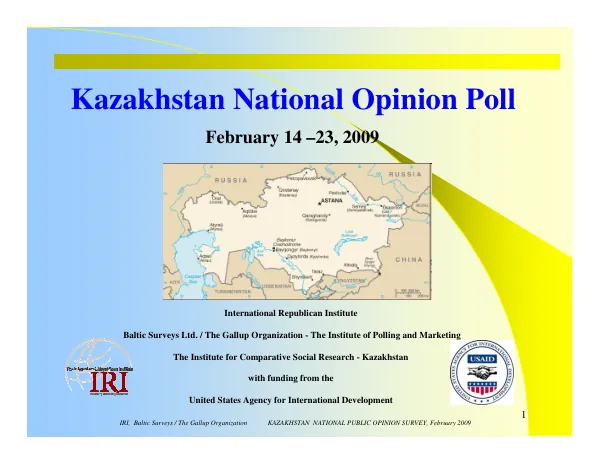
Kazakhstan National Opinion Poll, February 2009
Kazakhstan's national public opinion survey, conducted from February 14 to 23, 2009, aimed to gauge the country's social and economic indicators.
2009 · 51 pages
Sign in to readA free account is required to download.
Abstract
The survey was designed, coordinated, and analyzed by Baltic Surveys/The Gallup Organization on behalf of the International Republican Institute. Field work was carried out by the Institute for Comparative Social Research-Kazakhstan, with a sample of 1,519 Kazakh participants interviewed face-to-face in their homes. The survey's methodology involved a multi-stage probability sample, stratified into 16 regions, rural, urban, and metropolitan sampling units, and Primary Sampling Units (PSU). The closest birthday rule was used for respondent selection, and households were chosen using the random route method. The sample was distributed across all 16 regions of Kazakhstan, with a response rate of 65 percent. The margin of error for the survey results did not exceed plus or minus 2.5 percent with a confidence level of 95 percent. According to the survey, 79 percent of respondents believed that things in Kazakhstan were going in the right direction, while 12 percent thought they were going in the wrong direction. In terms of personal financial situation, 24 percent reported improvement, 21 percent reported worsening, and 31 percent reported no change in the past year. When asked about the economic situation in Kazakhstan over the next year, 44 percent expected it to get better, 33 percent expected it to get worse, and 17 percent expected it to remain the same. Respondents were also asked to rate the national authorities' performance on various issues. The highest ratings were given to poverty reduction (55 percent rated it as good or very good), employment (47 percent), and general country development (47 percent). The lowest ratings were given to corruption (14 percent rated it as good or very good) and democratic reforms (14 percent). Inflation control, fighting corruption, and fighting crime were also rated poorly, with only 14 percent, 14 percent, and 14 percent, respectively, rating them as good or very good. The survey also revealed that 35 percent of respondents considered inflation and price increase as the greatest concern, followed by unemployment and possibility of losing a job (21 percent), and low standard of living (13 percent). The national authorities' performance on these issues was rated poorly, with only 14 percent, 14 percent, and 14 percent, respectively, rating them as good or very good.