USAID
KHPP SubCLIN 1.4 – KDET Closeout Report
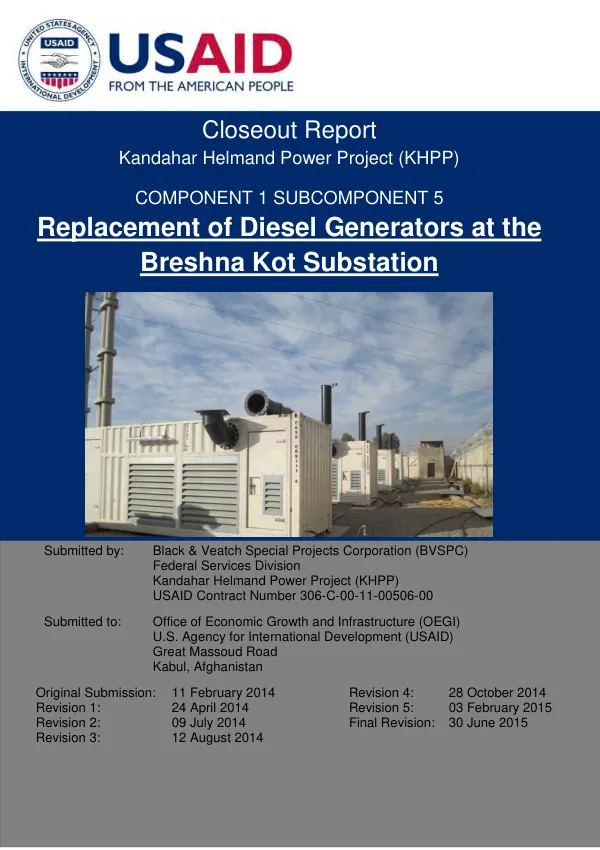
The Kandahar Helmand Power Project (KHPP) was a USAID-funded initiative aimed at increasing the supply and reliability of electrical power in southern Afghanistan, particularly in the City of Kandahar.
2014 · 21 pages
Sign in to readA free account is required to download.
Abstract
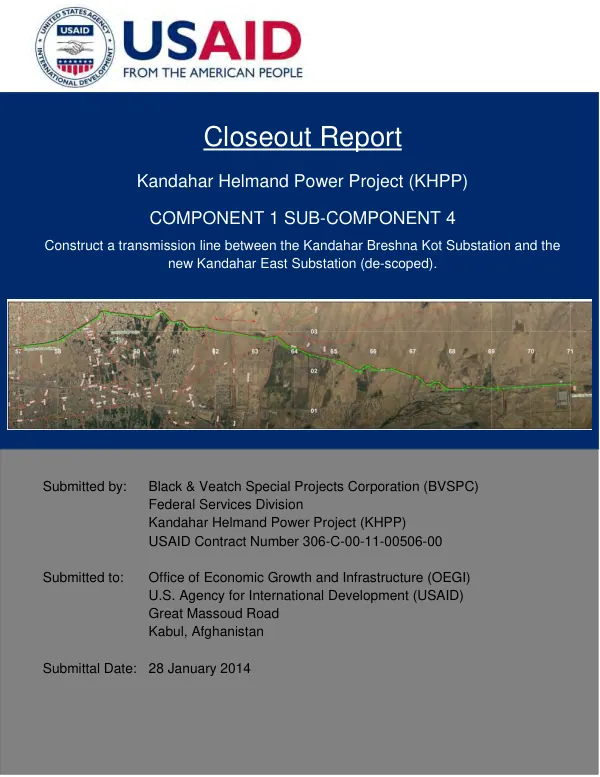
The project was part of the Southeast Power System (SEPS) reconstruction efforts. The KHPP contract was issued by USAID on December 9, 2010, and was valued at $306-C-00-11-00506-00. The project's primary objective was to construct a transmission line between the Kandahar Breshna Kot Substation and the new Kandahar East Substation. This transmission line was a critical component of the SEPS, as it would enable the reliable transmission of electrical power to the City of Kandahar and surrounding areas. The project's scope of work was divided into several components, with Component 1, Sub-Component 4 being the focus of the KHPP SubCLIN 1.4 – KDET Closeout Report. This component involved the construction of the transmission line, which was a critical infrastructure project that required careful planning, execution, and management. The project's execution was managed by Black & Veatch Special Projects Corporation (BVSPC), which was responsible for overseeing the construction of the transmission line. The project team worked closely with local stakeholders, including the Afghan government and local communities, to ensure that the project was completed on time and within budget. The project's physical completion was documented through various reports and photographs, which were submitted to USAID as part of the closeout process. The project's sustainability was also a key consideration, with the project team working to ensure that the transmission line would be maintained and operated effectively in the long term. The project's schedule was critical to its success, with several milestones and deadlines that needed to be met. The project team worked closely with USAID and other stakeholders to ensure that the project was completed on time and within budget. The project's safety and health program was also an important consideration, with the project team working to ensure that all workers were protected from harm and that the project was completed in a safe and healthy manner. The project's quality control program was also critical, with the project team working to ensure that the transmission line was constructed to the highest standards. The project's environmental impact was also a key consideration, with the project team working to minimize the project's environmental footprint and ensure that the transmission line was constructed in an environmentally responsible manner. The project's closeout process was completed on January 28, 2014, with the submission of the KHPP SubCLIN 1.4 – KDET Closeout Report to USAID. The report provided a comprehensive overview of the project's execution, including its physical completion, sustainability, and closeout process.