USAID
KHPP Subcomponent 2.1 – DJCN Closeout Report
The Kandahar Helmand Power Project (KHPP) is a USAID-funded initiative aimed at improving the power infrastructure in southern Afghanistan.
2014 · 44 pages
Sign in to readA free account is required to download.
Abstract
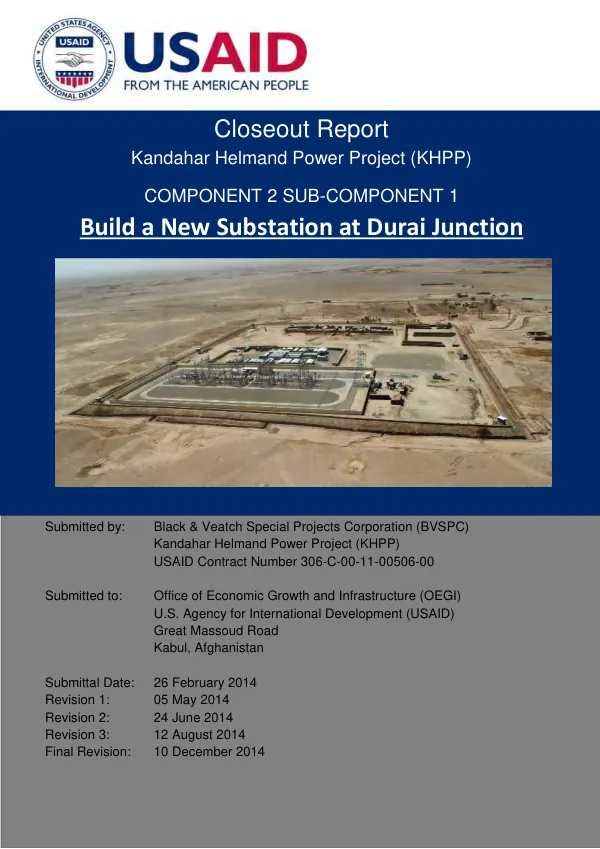
The project's primary objective is to increase the reliability and efficiency of the power grid, thereby enhancing economic growth and development in the region. The KHPP Subcomponent 2.1, Build a New Substation at Durai Junction, is a key component of the project. The subcomponent's objectives include rebuilding the Durai Junction substation, maintaining existing service for customers, and installing a breaker-and-a-half configuration with line positions for the transmission line from Kajaki towards Kandahar and Lashkar Gah. The subcomponent's history dates back to 2013, when the project was initiated. The construction of the new substation involved several modifications and change orders, which were documented and tracked throughout the project. The subcomponent's deliverables included the installation of 110/20 kV transformers, a 20 kV switchgear lineup, and a battery storage facility adjacent to the control building. The project's execution was managed by a team of professionals, who implemented the work according to the project schedule and budget. The team consisted of subcontractors and major procurements, which were carefully selected and managed to ensure the project's success. The budget and expenditures for the subcomponent were closely monitored, and the project's financial summary is provided in Table 5. The project's physical completion was documented through various means, including photo albums and as-built construction drawings. The project's sustainability was ensured through onsite training and learning objectives, which were designed to transfer knowledge and skills to the local workforce. The project's safety program and quality control plan were also implemented to ensure the well-being of the workers and the quality of the work. The project's environmental control plan was implemented to minimize the project's impact on the environment. The project's statement of patents, royalties, or classified materials is provided in Section 10, and the value engineering changes are documented in Section 11. The project's enhancing best practices and lessons learned are provided in Section 12, and the warranty is provided in Section 13. The project's outstanding issues are documented in Section 14, and the conclusion and impact assessment are provided in Section 15. The project's development experience clearinghouse (DEC) is provided in Section 16. The project's closeout report provides a comprehensive overview of the subcomponent's progress, achievements, and challenges. The report highlights the project's successes and lessons learned, which can be applied to future projects. The report also provides a detailed account of the project's financial summary, physical completion, and sustainability. The project's closeout package includes various attachments, which provide additional information on the project's implementation, including the contract closeout procedures manual, security plan, implementation plan, health and safety plan, quality control plan, warranty administration plan, construction manual, construction schedule, photo album, small business utilization subcontracting plan, operations and maintenance manuals, performance monitoring and evaluation plan, branding implementation plan, environmental plan, environmental compliance documentation schedule, environmental closeout report, weekly highlight report, short-term report, design submittals, inspection and equipment test reports, concrete strength tests, testing and commissioning report, as-built construction drawings, training reports, and final closeout report.