USAID DEC
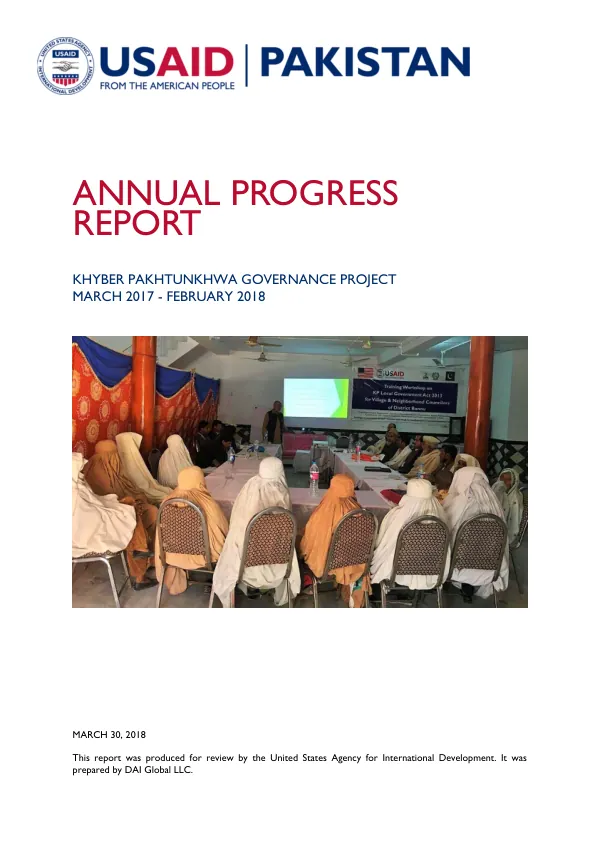
Annual Progress Report: Khyber Pakhtunkhwa Governance Project, March 2017 - February 2018
Sign inDAI GLOBAL, LLC
Annual Progress Report: Khyber Pakhtunkhwa Governance Project, March 2017 - February 2018
The Khyber Pakhtunkhwa Governance (KPG) project was awarded to DAI Global LLC on March 2, 2015, with a four-year duration and a budget of $22.6 million.
2018 · 33 pages
Sign in to readA free account is required to download.
Abstract
The project aims to bridge gaps in service delivery by improving governance, reducing corruption, and increasing citizen-state engagement in governance. The project's activities focus on both the supply and demand sides of governance initiatives. Supply side activities aim to enhance the capacity of the Khyber Pakhtunkhwa Provincial Government for implementing reforms and strengthening legislative frameworks, policies, regulations, structures, and institutions of public administration. This includes providing grants, local and international short-term technical assistance, and capacity-building initiatives such as training and mentoring. During the third year of implementation (March 2017 to February 2018), the project continued to develop packages of assistance that reinforced both the supply and demand sides of activities. A total of 26 grants were implemented, with more than $1.6 million worth of grants approved. The project also prepared over 30 proposals and concept notes, and engaged with government institutions, including the Local Government, Elections, and Rural Development Department, the Right to Information Commission, and the Planning and Development Department. On the supply side, activities such as staff trainings and equipment handover, along with software and customized information management systems, were implemented to improve the functioning of government departments. The Development Program Management System for the Planning and Development Department has enabled all district-level offices and local governments to start using the system, improving transparency and accountability of developmental funds. Under Outcome 1 (Service Delivery by Public Institutions Improved), the project has improved the operational efficiency of public sector organizations. Staff trainings and equipment handover have enhanced the capacity of government departments to provide services to existing customers and reach out to new customers in the province. Under Outcome 2 (Accountability of Government Service Providers Strengthened), the project has facilitated the capacity building of citizens to engage with the government on issues such as improvement of existing facilities and demand for new services and facilities. Grants have been implemented to promote dialogue between citizens and the state, train women groups in social audits, and incorporate citizens' charters in the development of district-level Annual Development Plans. Under Outcome 3 (Citizen's Capacity to Engage within and across Communities Strengthened), the project has focused on engaging communities, especially youth, through positive activities such as sports and recreational activities. The project has also built the capacity of women parliamentarians to identify issues of women for legislation and present these issues in the provincial assembly. The project has made significant progress in improving service delivery, strengthening accountability, and enhancing citizen engagement in governance. The project's activities have improved the operational efficiency of public sector organizations, built the capacity of citizens to engage with the government, and strengthened the ability of local state institutions to deliver essential services.