USAID DEC
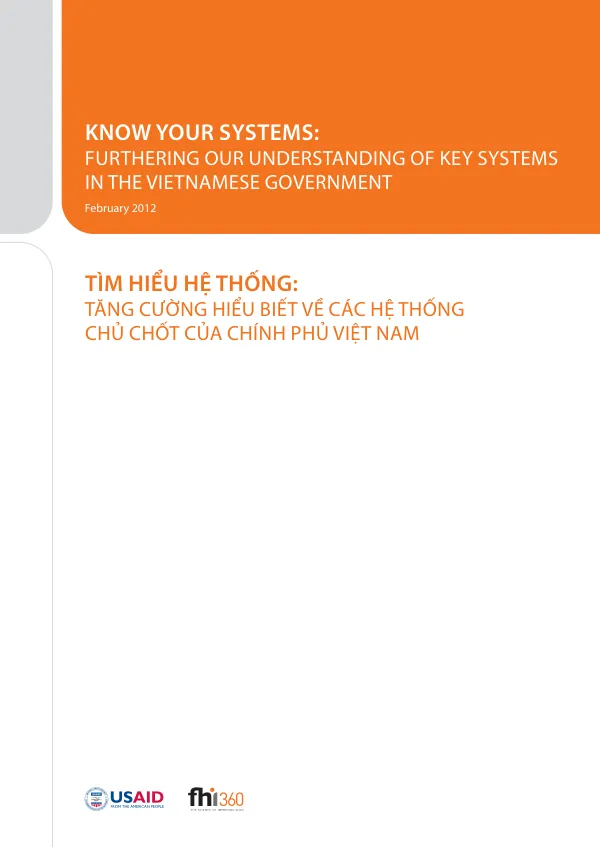
Know your Systems: Furthering our understanding of key systems in the Vietnamese government
Sign inMINISTRY OF FINANCE
Know your Systems: Furthering our understanding of key systems in the Vietnamese government
The Vietnamese government's organizational structure is composed of three main branches: the Legislative, Executive, and Judicial bodies.
2012 · 35 pages
Sign in to readA free account is required to download.
Abstract
The National Assembly (NA) serves as the highest legislative body, while the Government (Ministries) is responsible for implementing policies and laws. The Judicial bodies, including the People's Procuracy and the Supreme Court, ensure the enforcement of laws and regulations. At the provincial level, the Provincial People's Committee (PPC) serves as the highest executive body, overseeing the implementation of national policies and laws. The PPC is composed of the Provincial People's Council (PPC), which is responsible for making decisions on provincial-level policies and laws. The Provincial People's Committee is also responsible for coordinating the activities of various departments and agencies within the province. The Central HIV/AIDS Control System is a multisectoral organization established by the Prime Minister to direct and coordinate the prevention and control of HIV/AIDS, drug, and prostitution. The system is chaired by the Deputy Prime Minister and has five vice chairpersons from various ministries, including the Ministry of Health, Ministry of Labor, Invalids and Social Affairs, Ministry of Defense, and Ministry of Finance. The system's duties and authorities include directing the development of strategies, policies, and programs, organizing and directing cooperation among ministries, sectors, and localities, and consolidating and reporting implementation progress periodically. At the provincial level, the Provincial HIV/AIDS Control System is established to coordinate the prevention and control of HIV/AIDS, drug, and prostitution. The system is chaired by the Chairperson or Vice-Chairperson of the Provincial People's Committee and includes representatives from various departments and agencies, including the Department of Health, Department of Labor, Invalids and Social Affairs, and the Provincial Military Commanding. The Department of Health (DOH) is a technical body under the management of the People's Committees of provinces and cities, responsible for advising and assisting in the implementation of state governance in the health sector. The DOH is a legal entity with separate stamp and account, operating under the direction and management of the provincial People's Committee and the technical direction and guidance of the Ministry of Health. The DOH organizational structure includes the Director and Deputy Directors, appointed and dismissed by the Chairperson of the provincial People's Committee. The DOH has a cabinet, inspectorate, and technical divisions, including technical medicine, technical pharmacy, planning, finance, organization, and manpower management. The DOH also has administrative units attached to it, including medical care, preventive medicine, specialized aspects, health education and communication, health professional training, and evaluation and quality control. The Provincial HIV/AIDS Control Center (PAC) is a department within the DOH, responsible for coordinating the prevention and control of HIV/AIDS, drug, and prostitution at the provincial level. The PAC has a director and deputy directors, and is composed of several divisions, including counseling, care, and treatment, communication, intervention, HIV/STD counseling, and monitoring and evaluation.
Related documents