FHI 360
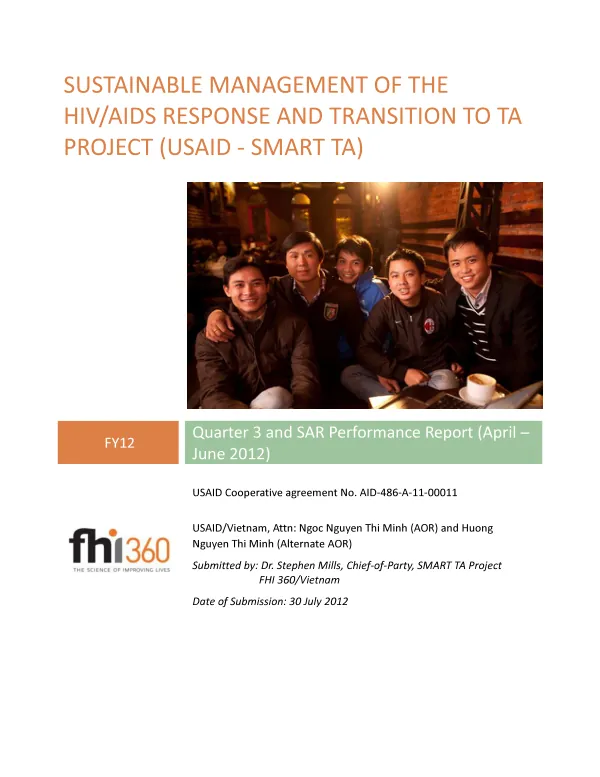
SMART TA FY12 Quarter 3/SAR Performance Report
The USAID Sustainable Management of the HIV/AIDS Response and Transition to Technical Assistance Project, or SMART TA, is a five-year, 45 million USD initiative that aims to ensure the provision of quality comprehensive and sustainable HIV services through a strengthened national response in Vietnam.
2012 · 49 pages
Sign in to readA free account is required to download.
Abstract
The project is designed to contribute directly to the targets identified in the National Strategy on HIV/AIDS Prevention and Control in Vietnam and the Partnership Framework Between the Government of the United States of America and the Government of the Socialist Republic of Vietnam for HIV/AIDS Prevention and Control. SMART TA works in collaboration with the Government of Viet Nam (GVN), the President's Emergency Plan for AIDS Relief (PEPFAR), other key stakeholders, and over 30 local agencies to implement the project and deliver results across three main strategic objectives. The first objective is to deliver quality HIV services within the continuum of HIV prevention and care (CoPC). The second objective is to transition financial, administrative, and technical ownership of CoPC services to the GVN and other stakeholders. The third objective is to strengthen technical capacity and country ownership to sustain quality HIV services. The guiding principles of SMART TA are country ownership, sustainability, participation, and accountability, quality improvement, and coordination and collaboration. Over a five-year period, SMART TA will work towards several key results, including transitioning 100% of SMART TA-supported CoPC interventions, partners, and sites to the GVN and local partners, with resources coming from the government, other donor sources, and efficiency gains. SMART TA will assist the GVN to transition strategic information efforts and core and supplementary packages of HIV prevention and care services in focus provinces and beyond. The project will assess the capacity of the GVN and civil society organizations (CSOs) to implement individualized CoPC interventions for each province and develop annual capacity-building plans. SMART TA will also collaborate on the development of cost-effective CoPC models and service packages that can be replicated using local resources. The transition of financial, administrative, and technical responsibilities for the implementation of HIV CoPC programs supported by SMART TA will require national and provincial consensus building, capacity assessment, standardization of models and service packages, development of individual provincial transition plans, technical support, and ongoing monitoring and quality improvement. SMART TA will work with USAID, the Ministry of Health (MOH), the Vietnam Administration for HIV/AIDS Control (VAAC), the Ministry of Labor, Invalids and Social Affairs (MOLISA), the Ministry of Planning and Investment (MPI), the Ministry of Finance (MF), Provincial AIDS Centers (PACs), CSOs, Pathways partners, PEPFAR, and other stakeholders to transition 100% of the current FHI 360 implementation portfolio to the GVN and relevant CSOs by Year 5. SMART TA's FY12 Quarter 3 Performance Report for the period 01 April to 30 June 2012 includes performance indicators from Quarter 3 and cumulative indicators since the beginning of the project period. The report outlines progress towards strategic objectives and program indicators, project management and personnel requirements, information on cost overruns, next reporting period technical assistance and international travel priorities, and SMART TA success stories. SMART TA strives to achieve results across three main strategic objectives: delivering quality HIV services within the CoPC, transitioning financial, administrative, and technical ownership of CoPC services to the GVN and other stakeholders, and strengthening technical capacity and country ownership to sustain quality HIV services. The project will ensure quality across implementing programs while transitioning full ownership to the GVN and CSOs. SMART TA will collaborate on the development of efficient and cost-effective core and supplementary service packages that can be replicated in medium- and low-resourced provinces. SMART TA will work with the GVN and other stakeholders to develop individual provincial transition plans, provide technical support, and conduct ongoing monitoring and quality improvement. The project will also assess the capacity of the GVN and CSOs to implement individualized CoPC interventions for each province and develop annual capacity-building plans. SMART TA will collaborate on the development of cost-effective CoPC models and service packages that can be replicated using local resources. SMART TA's FY12 Quarter 3 Performance Report highlights progress towards strategic objectives and program indicators, including the delivery of quality HIV services within the CoPC, transitioning financial, administrative,