USAID
La familia Callisaya observa los cambios generados por su lombricario familiar
The Callisaya family has successfully implemented a lombricario, or worm composting system, on their property.
2013 · 2 pages
Sign in to readA free account is required to download.
Abstract
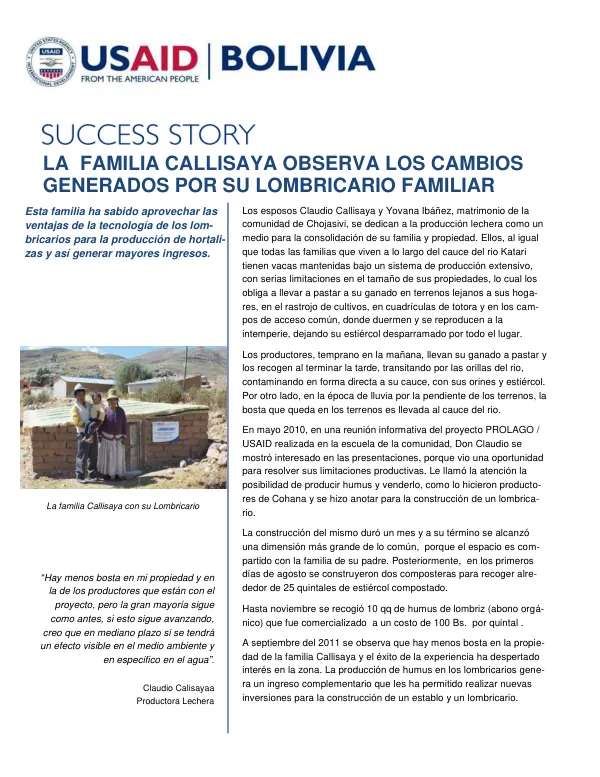
This initiative has allowed them to generate additional income through the sale of humus, a nutrient-rich organic fertilizer. The family's experience with the lombricario has also led to a reduction in waste and improved environmental conditions. The Callisayas are dairy farmers who previously struggled with the limitations of their property size and the need to graze their cattle in distant areas, resulting in the dispersal of manure and contamination of the Katari River. However, after learning about the potential of lombricarios at a USAID-sponsored meeting in 2010, Claudio Callisaya saw an opportunity to address these challenges. He constructed a lombricario on his property, which was later expanded to accommodate his family's needs. The lombricario has enabled the Callisayas to collect and process manure, producing a valuable commodity that can be sold. In the first year, they collected 10 quintals of humus, which was sold at a price of 100 Bolivianos per quintal. The success of this initiative has sparked interest in the surrounding area, and the Callisayas have been able to invest in new infrastructure, including a stable and additional lombricario. The Callisayas consider the lombricario to be a profitable and accessible technology that requires minimal inputs. They have also acquired skills related to manure management through technical assistance. The family has been able to utilize the humus produced by the lombricario to improve their agricultural productivity, growing crops such as potatoes and vegetables. They have also used the lombricario to maintain a layer of agrofilm, which helps to retain moisture and suppress weeds. Currently, the Callisayas are expanding their lombricario capacity to produce 15 quintals of humus every three months. Their experience serves as a model for other farmers in the region, demonstrating the potential of lombricarios to improve agricultural productivity, reduce waste, and generate income.