USAID DEC
Labor Productivity and Employment in Manufacturing in Indonesia
Labor productivity and employment in Indonesia's manufacturing sector have become pressing concerns for policymakers.
2013 · 8 pages
Sign in to readA free account is required to download.
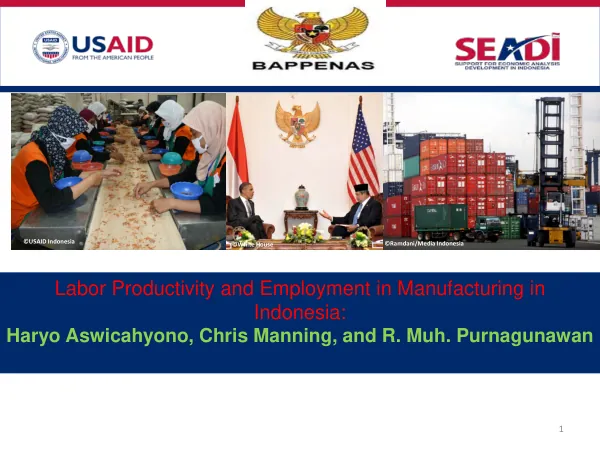
Abstract
The country faces a delicate balance between the aspirations of workers to earn higher wages and the need for competitive labor costs and productivity to ensure sufficient jobs. This challenge is further complicated by the need to consider the long-term employment and productivity impacts of government labor policies. Indonesia's manufacturing sector has experienced a decline in competitiveness, with exports and foreign direct investment (FDI) no longer driving growth. Labor-intensive industries are struggling, and the country has fallen behind China, India, and Vietnam in terms of manufacturing output and job creation. The shift towards more resource- and capital-intensive investment has exacerbated this issue, leading to a decline in labor-intensive industries. Labor productivity growth in Indonesia has been hindered by changes in institutions and the emergence of the "missing middle" phenomenon. Large firms provide fewer regular jobs, while small firms fail to progress and miss out on economies of scale. This has resulted in a decline in labor productivity growth, with the country's GDP and labor productivity growth rates lagging behind those of its Asian peers. Figure 1 illustrates the growth in GDP and labor productivity in selected Asian countries between 2000 and 2008. Indonesia's labor productivity growth rate of 3.7% per annum was significantly lower than that of China, India, and Vietnam. Figure 2 shows the distribution of value added by firm size in Indonesia's manufacturing sector in 2010, with large firms accounting for the majority of value added. Figure 3 illustrates the distribution of employment by firm size, with small firms dominating the sector. Policymakers face significant challenges in addressing the labor productivity and employment issues in Indonesia's manufacturing sector. Key policy questions include what policies are needed to create more jobs and sustain productivity improvements, how to control rising labor costs while protecting formal sector workers, and what policies are required to preserve jobs in unskilled, labor-intensive industries. The presentation will discuss Indonesia's performance in an international perspective, trends and determinants of employment growth, labor demand, and unit labor costs, as well as a case study of labor management practices and their relationship to labor costs, productivity, and employment.
Related documents
Documents in this collection
 2013
2013USAID DEC
Outsourcing and the Constitutional Court Decision Issues in Indonesia and Abroad, and Possible Solutions
Open record 2021
2021USAID DEC