USAID
Land Classification Delegated Authorities Tenure Brief
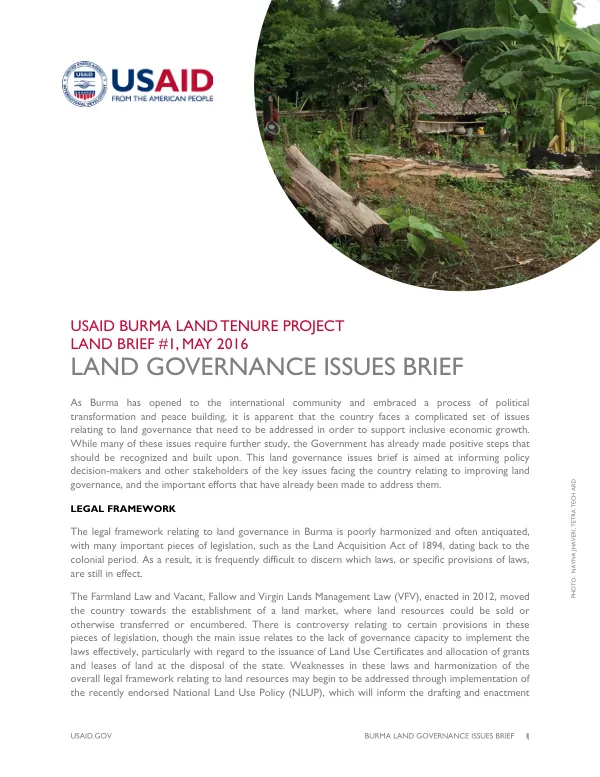
The land classification system in Burma is highly complex and complicated, with multiple categories and classifications that can be difficult for local populations to understand.
2018 · 7 pages
Sign in to readA free account is required to download.
Abstract
This complexity causes confusion at the grassroots level, making the securing of tenure rights unnecessarily difficult and expensive. Land at the disposal of the government, also known as VFV land, is a category that includes land not classified as forest land, with the exception of land where a government department, organization, or individual has acquired a right of cultivation, possession, use, or occupancy. This category is further divided into grant land, which is technically owned by the government and found in urban areas, towns, and village settlement areas, and vacant, fallow, and virgin land, which is a type of land at the disposal of the government found in rural areas. Freehold land, also known as ancestral land, is a classification of land found mostly in large cities and towns, and is directly transferable. Grant land, on the other hand, is transferable but may be reclaimed by the government at the end of a lease period or for a public purpose. Town land, a classification that existed under the repealed Land Nationalization Act of 1953, was commonly referred to as "La Na 39 Land" and was transferable and could be upgraded to grant land. Village land, which includes areas of a formally recognized village where housing is situated and the surrounding lands, is transferable and is the responsibility of the government to survey and map. Common land, which may be considered as common access public lands of a village, includes areas such as pasture or grazing lands and is not transferable but may be reclassified. Grazing land, also commonly referred to as pasture land, is a form of village common land historically used for the grazing of livestock and may not be transferred but may be reclassified for other uses. Vacant, fallow, and virgin land, a type of land at the disposal of the government found in rural areas, does not include areas currently classified as forest land and is defined in the 2012 VFV Lands Management Law. This category includes land that was tenanted in the past and abandoned for various reasons, as well as land that has never been cultivated. VFV land allocations function as a lease of state land and may be reclaimed by the government if the terms of the permit are not complied with or if the government needs to acquire the land for a public purpose. Farmland, commonly referred to as agriculture land, is defined in the Farmland Law of 2012 and includes land used for agriculture, livestock production, and aquaculture production. The Law defines farmland as land used for low land (paddy land), upland (Ya), silty land (Kaing Kyun), hillside cultivation land (Taungyar), perennial crops land, nipa palm land (Dhani), garden land or horticultural land, and alluvial land. The sub-classifications found within the Farmland Law are largely based on a classification system used for taxation purposes during the British colonial period.
Related documents