USAID DEC
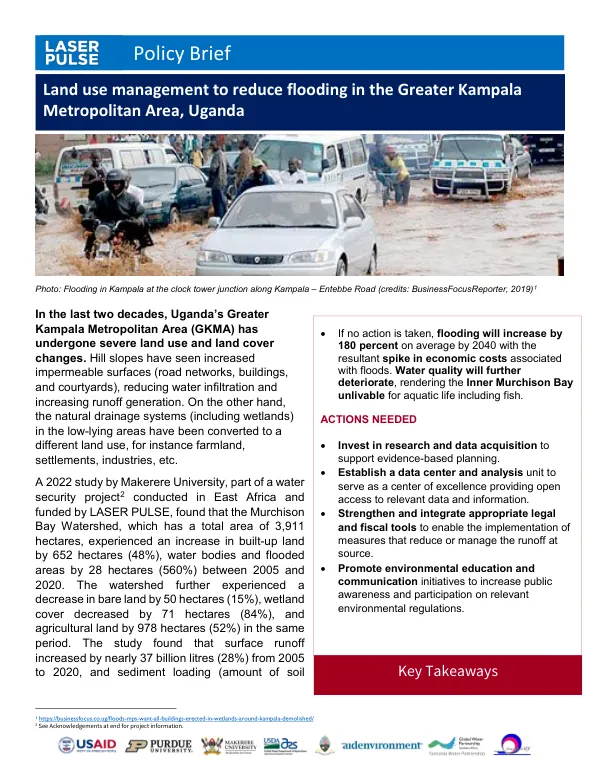
Land use management to reduce flooding in the Greater Kampala Metropolitan Area, Uganda
Sign inUNIVERSITY OF MARYLAND
Land use management to reduce flooding in the Greater Kampala Metropolitan Area, Uganda
The Greater Kampala Metropolitan Area (GKMA) in Uganda has undergone significant land use and land cover changes over the last two decades.
2023 · 4 pages
Sign in to readA free account is required to download.
Abstract
Hill slopes have seen increased impermeable surfaces, such as road networks, buildings, and courtyards, reducing water infiltration and increasing runoff generation. Conversely, natural drainage systems in low-lying areas have been converted to different land uses, including farmland, settlements, and industries. A 2022 study by Makerere University found that the Murchison Bay Watershed, which spans 3,911 hectares, experienced a 48% increase in built-up land, a 560% increase in water bodies and flooded areas, and a 52% decrease in agricultural land between 2005 and 2020. The study also revealed that surface runoff increased by nearly 28% during the same period, resulting in a 37 billion-liter increase in surface runoff. Sediment loading in running water increased by 300 grammes for every 20 liters, while groundwater replenishment decreased by at least 15 billion liters. The increased runoff generation has led to destructive flooding and flash-flood episodes in the GKMA, posing severe socio-economic challenges to both businesses and residents. Kampala Capital City alone suffers an average annual damage of US$49.6 million to buildings, with over 170,000 people frequently affected by floods, according to 2021 estimates by the World Bank. If no action is taken, the risk of flooding in the GKMA is expected to increase by 180% on average by 2040, resulting in a significant spike in economic costs associated with floods. Water quality will further deteriorate, rendering the Inner Murchison Bay uninhabitable for aquatic life, including fish. The resultant increase in biochemical oxygen demand will require a rise in the water tariff by the National Water and Sewerage Corporation. To mitigate these challenges, an integrated approach to flood management is necessary, considering upstream-downstream relations, integrating surface runoff generation into land use plans, and restoring natural drainage systems such as wetlands. Investment in research and data acquisition is critical to support evidence-based planning, providing an understanding of natural resources and services in the urban area. The Ministry of Water and Environment needs to survey, map, and demarcate the boundaries of natural resources in the GKMA, such as wetlands and forests, and locate sediment, runoff generation, and flooding hotspots. This will strengthen environmental legislation based on statistical data and maps generated to guide the enactment of by-laws and compliance enforcement. Strengthening and integrating appropriate legal and fiscal tools would be necessary to compel and incentivize owners or managers of public, industrial, and residential buildings to implement measures that reduce the runoff leaving their property. The research by Makerere University found that a combination of grassed waterways, vegetated filter strips, and detention ponds reduced surface runoff and sediment load in the Murchison Bay watershed by 79% and 68%, respectively. Establishing a data center and analysis unit would serve as a Center of Excellence for Water Security, providing open-access to related data and information, supporting evidence-based planning, and developing the infrastructure and human resources needed to support the center and water resources planning and management in general. Promoting environmental education and communication initiatives would increase public awareness and participation in relevant environmental regulations. Communities play a pivotal role in environmental sustainability, and public education and communication initiatives will sensitize communities on the benefits of environmental conservation within the urban environment. The existing legal framework sets the stage for responsible land use management and development that does not come at the expense of the environment. The Constitution of the Republic of Uganda 1995 requires the State to protect important natural resources, including land, water, wetlands, minerals, oil, fauna, and flora on behalf of the people of Uganda. The Policy on Conservation and Management of Wetland Resources (1995) aims to sustain wetlands' value for present and future well-being of the people. The Water Act Cap 152 (1997) advocates for the involvement of all stakeholders in planning for the utilization, development, and management of water resources.
Related documents
Documents in this collection
 2021
2021USAID DEC
Financing the HIV Response in Uganda: Emerging Trends and Policy Options from National AIDS Spending Assessments
Open record 2021
2021USAID DEC