USAID
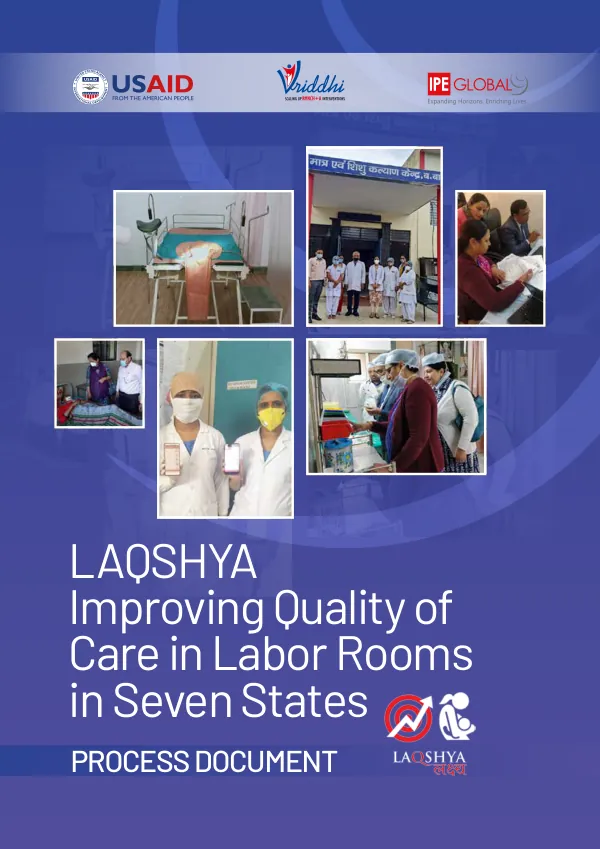
LAQSHYA – Improving Quality of Care in Labor Rooms in Seven States
The Labor Room Quality Improvement - LaQshya program is a flagship program launched by the Ministry of Health and Family Welfare in December 2017.
2021 · 36 pages
Sign in to readA free account is required to download.
Abstract
The program aims to improve the quality of care for mothers and newborns at public health facilities. LaQshya provides an institutional framework to address the challenges in providing quality care, including poor-quality care, inadequate infrastructure, and lack of skilled healthcare providers. The program focuses on improving the quality of care in labor rooms and operating theaters in seven states: Jharkhand, Uttarakhand, Odisha, Chhattisgarh, Haryana, Punjab, and Himachal Pradesh. The program targets 25 Aspirational Districts in these states, where the quality of care is particularly poor. LaQshya aims to reduce maternal and newborn mortality by improving the quality of care, increasing access to healthcare services, and enhancing the capacity of healthcare providers. The LaQshya Program Management Unit, established at the national level, provides technical and managerial support to the Ministry of Health and Family Welfare and state National Health Missions for the roll-out of the LaQshya program. The PMU coordinates support for mentoring states and facilities on capacity building, preparing work plans and budgets, and monitoring the progress of the program. Vriddhi, a technical partner for Maternal Newborn Health, has been instrumental in helping states translate LaQshya national guidelines into action. Vriddhi facilitated the setup and operationalization of the LaQshya institutional framework, comprising State Mentoring Group, Technical Support Unit, District Coaching Teams, and Quality Circles. The project supported states in defining state targets, prioritizing facilities, conducting baseline assessments, and developing programmatic tools for program managers. Quality Improvement was enforced by USAID Vriddhi through concurrent advocacy for QI methodology, capacity building of LaQshya facility staff on processes, tools, and implementation of the same in Aspirational Districts. The project developed program monitoring tools that facilitate monitoring, identifying gaps, and developing action plans. The project also integrated Safe Delivery App, a mobile-based educational tool to improve the quality of care around birth. The COVID-19 pandemic has been challenging for the LaQshya program, with efforts and resources of health departments diverted towards COVID-19. Vriddhi project aligned its activities to strengthen selected facilities for managing mothers and newborns during the pandemic. The project provided support for the development of the COVID-19 module for Safe Delivery App and rolled it out across 7 intervention states. As a result of the support, baseline assessments have been completed in 360 Labor Room units and 296 Operating Theaters in the 7 states for LaQshya certification. Capacity building of LaQshya facilities on components of LaQshya and technical requirements was done in 39 Aspirational Districts and 87 non-Aspirational Districts, training 1920 healthcare providers across the 7 states. All seven project states have made considerable progress towards LaQshya certification, with 132 state certifications of Labor Rooms and Operating Theaters.