USAID DEC
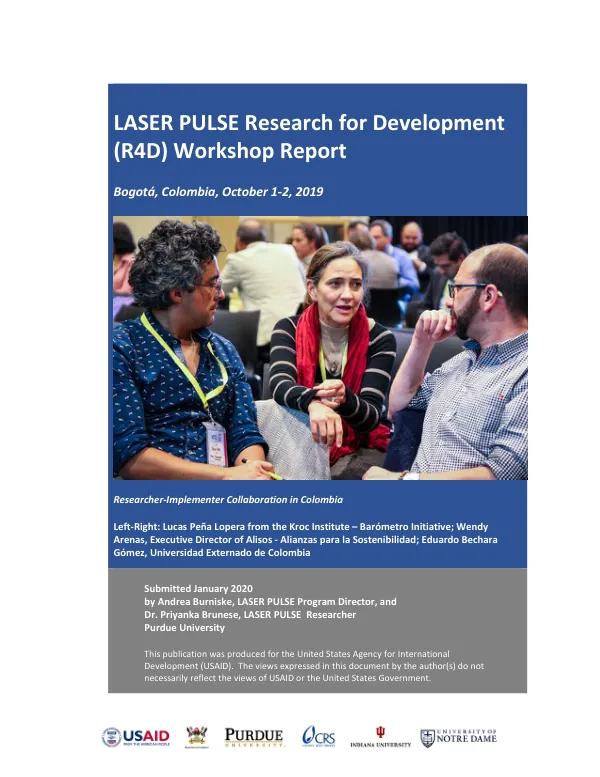
LASER PULSE Research for Development (R4D) Workshop Report: Researcher-Implementer Collaboration in Colombia
Sign inNOTRE DAME UNIVERSITY
LASER PULSE Research for Development (R4D) Workshop Report: Researcher-Implementer Collaboration in Colombia
The LASER PULSE Research for Development (R4D) workshop was a 1.5-day event held on October 1st and 2nd, 2019, in Bogotá, Colombia.
2020 · 31 pages
Sign in to readA free account is required to download.
Abstract
The workshop included more than 100 participants from various sectors, including USAID, NGOs, the United Nations system, university researchers, the Colombian Government, and private sector representatives. The purpose of the workshop was to convey and model the strategy of researcher-implementer collaboration on development solutions around three sector topics: integrated rural development, youth, and the Venezuelan migrant crisis. The LASER PULSE program is a five-year USAID-funded initiative implemented by a consortium of universities and non-governmental organizations. The program aims to support the discovery and uptake of research-sourced, evidence-based solutions to development challenges in USAID interest countries. LASER PULSE's implementation approach comprises three pillars: research capacity building, embedded research translation, and sustainable networks. The R4D events, held in rotating regions in countries where USAID has a presence, provide an opportunity to identify gaps in sector systems and co-design solutions to development challenges. The events focus on successful translation of research to products, practices, or policies as solutions to development challenges. Comprehensive Success Factor Analysis (CSFA) is a methodology applied in all phases of the event to refine sector focus areas and engage researchers and practitioners in discussions around key gaps and research opportunities. The Colombia R4D workshop was designed to refine the three priority sector focus areas proposed by USAID/Colombia Mission: youth, Venezuela migration response, and integrated rural development. The workshop aimed to convene stakeholder representatives to promote critical thinking on collaborative development opportunities, facilitate connections and opportunities for collaboration between researchers and development actors, and build the capacity of prospective research team applicants to submit competitive proposals for the R4D Research Grants. The workshop context was informed by the more than 50 years of armed conflict that has isolated the Colombian countryside, leaving millions of Colombians displaced. The Peace Accord between the Colombian government and the Revolutionary Armed Forces of Colombia (FARC) established in 2016 provides guidance on implementation of the Accord through stipulations. The third phase of the peace process - Building Peace - depends on enacting provisions that address both the root causes and the impacts of the conflict. The response to the migrant crisis is based on protocols for provision of humanitarian assistance, including shelter, food, and healthcare. The influx of approximately 1.1 million migrants from Venezuela to Colombia has complicated the implementation of the Peace Accord stipulations. The Development Programs with a Territorial Focus (PDET) are a sub-regional program for the integral transformation of the rural Colombia, focusing on 16 conflict-impacted territories comprising 170 municipalities. The workshop outcomes and accomplishments included the refinement of sector focus areas, engagement of researchers and practitioners in discussions around key gaps and research opportunities, and the identification of potential research themes in the Colombian context. The CSFA sector analysis was used to narrow the focus on inputs for grant round RFA that follows each conference. The workshop also aimed to build the capacity of prospective research team applicants to submit competitive proposals for the R4D Research Grants.
Related documents