USAID DEC
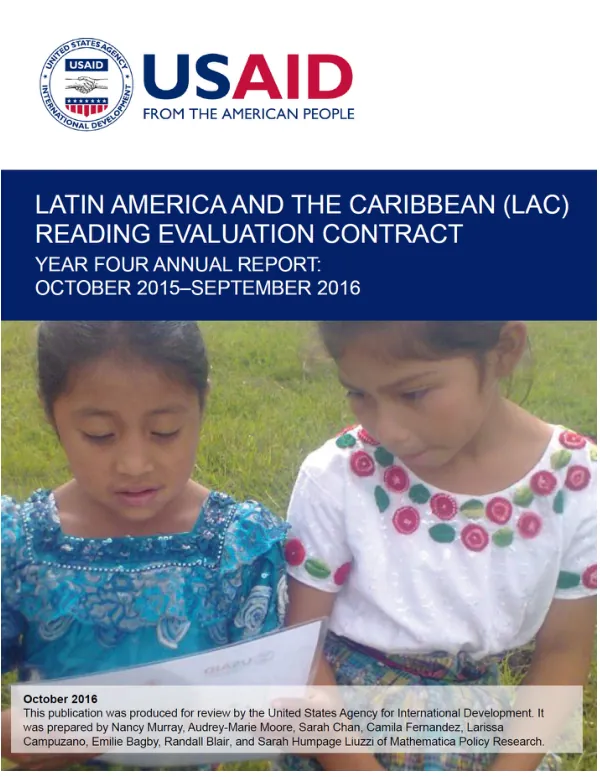
Latin America and the Caribbean (LAC) Reading Evaluation Contract: Year Four Annual Report: October 2015-September 2016
Sign inUSAID DEC
Latin America and the Caribbean (LAC) Reading Evaluation Contract: Year Four Annual Report: October 2015-September 2016
Latin America and the Caribbean Reads (LAC Reads) is an activity funded by the United States Agency for International Development (USAID) that seeks to improve reading outcomes in the early primary grades, especially among disadvantaged children with low literacy rates.
2016 · 148 pages
Sign in to readA free account is required to download.
Abstract
The USAID Office of Regional Sustainability contracted with Mathematica Policy Research to lead the LAC Reading and Education Evaluation Services, which aims to provide technical assistance and support to USAID missions in the region to improve reading outcomes. The LAC Reads activity focuses on improving reading outcomes in six countries: Guatemala, Honduras, Nicaragua, El Salvador, Peru, and the four countries of Central America. The activity involves a range of interventions, including teacher training, curriculum development, and community engagement. The goal of the activity is to improve reading outcomes among disadvantaged children, particularly those in rural and marginalized communities. The LAC Reads activity is implemented through a series of evaluations, which are designed to assess the effectiveness of different interventions and provide recommendations for improvement. The evaluations are conducted in partnership with local organizations and involve a range of research methods, including surveys, interviews, and observations. The evaluations are organized into seven components, each focusing on a different country or region. Evaluation 1 focuses on Guatemala and Peru, where the Leer Juntos, Aprender Juntos (Learn Together, Learn Together) program is being implemented. The program aims to improve reading outcomes among disadvantaged children by providing teacher training and community engagement. Evaluation 2 focuses on Honduras, where the Data-Driven Instruction in Honduras program is being implemented. The program aims to improve reading outcomes among disadvantaged children by providing teachers with data-driven instruction and community engagement. Evaluation 3 focuses on Nicaragua, where the Community Action for Reading and Security: Espacios para Crecer (Spaces for Growth) program is being implemented. The program aims to improve reading outcomes among disadvantaged children by providing community-based interventions and teacher training. Evaluation 4 focuses on Peru, where the Amazonia Lee program is being implemented. The program aims to improve reading outcomes among disadvantaged children by providing teacher training and community engagement. Evaluation 5 focuses on Nicaragua, where the CARS Performance Evaluation program is being implemented. The program aims to improve reading outcomes among disadvantaged children by providing performance evaluation and community engagement. Evaluation 6 focuses on El Salvador, where the Impact Evaluation of the Workforce Investment Activity program is being implemented. The program aims to improve reading outcomes among disadvantaged children by providing workforce investment and community engagement. Evaluation 7 focuses on Central America, where the Workforce Development Learning Agenda program is being implemented. The program aims to improve reading outcomes among disadvantaged children by providing workforce development and community engagement. The evaluations are designed to assess the effectiveness of the different interventions and provide recommendations for improvement. The evaluations involve a range of research methods, including surveys, interviews, and observations. The results of the evaluations will inform the development of future interventions and provide insights into the most effective ways to improve reading outcomes among disadvantaged children in the region.
Related documents