USAID DEC
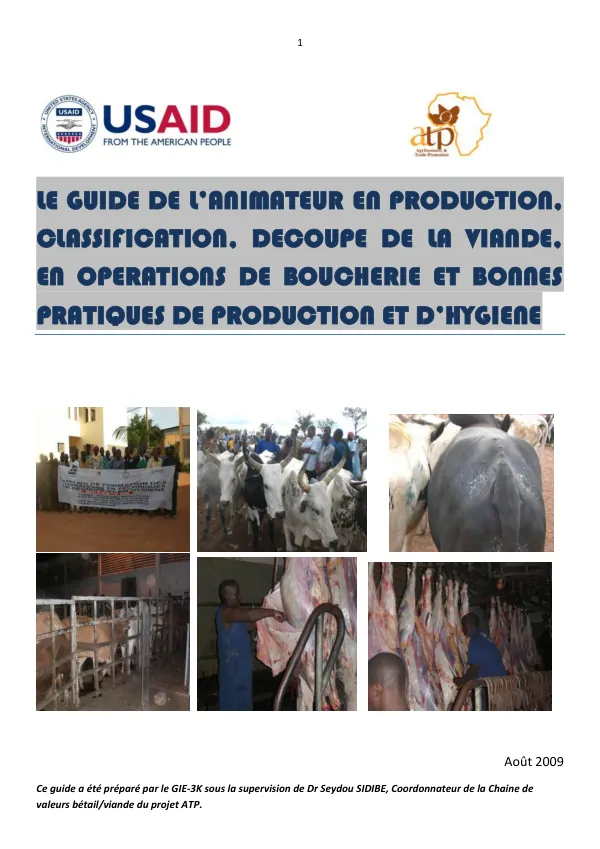
Le Guide de l’Animateur en Production, Classification, Découpe de la Viande, en Opérations de Boucherie et Bonnes Pratiques de Production et d’Hygiène
Sign inUSAID
Le Guide de l’Animateur en Production, Classification, Découpe de la Viande, en Opérations de Boucherie et Bonnes Pratiques de Production et d’Hygiène
The guide for animators in meat production, classification, and cutting, as well as good practices in production and hygiene, was prepared by GIE-3K under the supervision of Dr.
2009 · 30 pages
Sign in to readA free account is required to download.
Abstract
Seydou Sidibe, Coordinator of the Livestock/Meat Value Chain of the ATP project, in August 2009. The guide aims to form a new generation of butchers not only in good hygiene practices but also in cutting, presentation, and conservation of meat techniques. The animator's role is to facilitate the learning process and help participants find solutions to their problems. The animator should use a participatory approach based on adult pedagogy (andragogy) and put the participants at the center of the learning process. The animator should respect the participants' experience and use it as a basis for participation in all stages of the animation session. The animator should identify and analyze the needs of the participants, establish their expectations based on their experiences, and create a learning environment that is participatory and respectful of the participants. The animator should also be able to complete a sequence partially and improvise in response to what they perceive during the training session. To organize a training session, the animator should first formulate the themes or objects of the training, identify the problems that these themes pose, define the possible solutions, and highlight the training solutions that can resolve the identified problems. The animator should also be aware of the principles, good sense, and good conduct to be observed during the training session. Some of the aptitudes and attitudes that the animator should develop include mastering the techniques of animation, being able to observe and analyze the phenomena of the group, and being able to complete a sequence partially and improvise in response to what they perceive during the training session. The animator should also be able to identify and analyze the needs of the participants, establish their expectations based on their experiences, and create a learning environment that is participatory and respectful of the participants. The animator should also be aware of the characteristics of adult learners, such as their motivation to learn when they discover their needs and interests that can be satisfied through a training session, their learning style centered on reality, and their aspiration to determine themselves. The animator should also be able to vary the styles, durations, and locations of the training session to accommodate the differences in personalities among the participants. To be a good animator, one should be competent in the tasks of the professional conscience, initiatives, organization of work, and role of the animator. The animator should also be sociable, humble, available, and presentable, and have a sense of humor. The animator should also be able to observe and listen, be neutral and objective, and have a mastery of themselves. The objectives of the training session should be to provide a group of people interested in the content of the training modules with a learning experience that is participatory and respectful of the participants. The training session should be designed to meet the needs of the participants and provide them with the skills and knowledge they need to improve their performance in their profession.
Related documents