DAI
LEARNING NOTE: NAVIGATING FIRM SELECTION FOR WOMEN-INCLUSIVE ROI
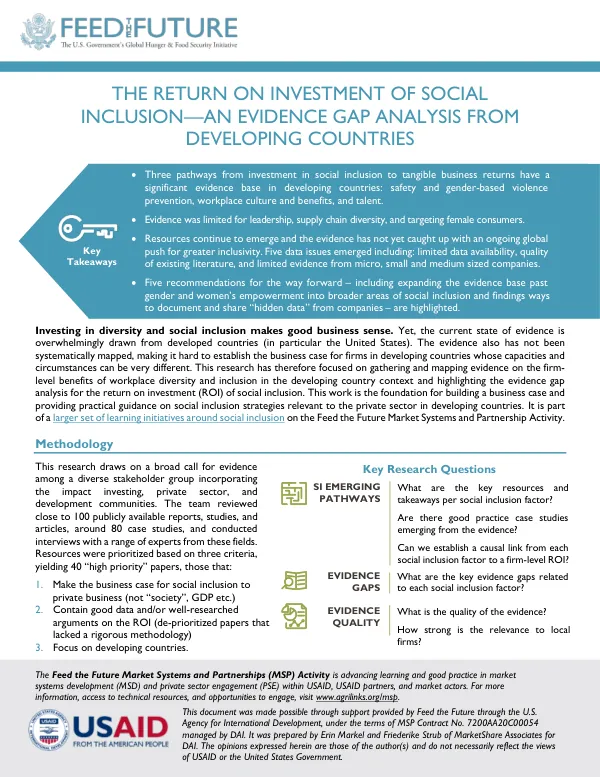
The Feed the Future Market Systems and Partnerships (MSP) Activity is advancing learning and good practice in market systems development (MSD) and private sector engagement (PSE) within USAID, USAID partners, and market actors.
2024 · 4 pages
Sign in to readA free account is required to download.
Abstract
The MSP Activity is part of the Feed the Future initiative, which aims to empower women in the workplace and generate direct financial benefits for firms. A series of case studies under the MSP Activity's Social Inclusion Learning Stream seeks to strengthen the evidence on the return on investment (ROI) of women-inclusive business strategies for small- to medium-sized enterprises (SMEs) in low- and middle-income countries (LMICs). The learning note provides key insights gained from the process of vetting and selecting companies for women-inclusive return on investment (WI-ROI) calculations. Three considerations are important when selecting and vetting companies for WI-ROI calculations: understanding the inclusive business model, including if and how benefits accrue to women; assessing if the women-inclusive business model can be compared to "business-as-usual"; and ensuring the company has high-quality cost and revenue data to participate in the process. The WI-ROI framework allows portfolio managers and private sector engagement practitioners to evaluate the financial performance of investments and guide the process of selecting and vetting firms to create a portfolio that maximizes social impact. The WI-ROI framework categorizes inclusive investments into commonly used business strategies, ensuring isolation and establishing a link between the investment and potential financial metrics. Developing a Theory of Change (ToC) helps to articulate the expected financial returns for the company and empower women. Validating the potential impact on women outlined in the ToC is a critical next step, requiring a detailed understanding of the business strategy. In one case, an SME was pre-selected, committed to the research, and shared high-quality financial statements. However, during the development of the ToC, it was determined that women farmers were not likely to successfully integrate into the agricultural input supply chain as envisaged, and there was a considerable risk of future benefits being captured by the women's husbands in the given context. As a result, the SME was not selected. The feasibility to compare the business-as-usual strategy to the women-inclusive model is also a critical consideration. The WI-ROI requires comparing unique business investments over time, establishing a clear before (baseline) and after (endline) scenario. This is necessary to identify the difference in costs and revenues between the two business models. In some cases, deriving a WI-ROI is straightforward, while in others, it is challenging due to the complexity of the business model and the lack of quality cost data. Data availability was a prerequisite for selecting companies for the WI-ROI studies. Companies shared audit statements as proof of good bookkeeping and completed Excel sheets on the data that was likely needed. In subsequent exchanges with company management, data availability was explored, and the research team communicated the selection criteria, including the need for audit statements and proof that companies tracked required data. An iterative process of data analysis and requesting and receiving additional data was key to calculating the WI-ROI.