THE AMERICAN INSTITUTES FOR RESEARCH
Lessons from LAC Reads: EducAcción Promising Reading Intervention in Honduras
The EducAcción Promising Reading Intervention (EducAcción-PRI) was designed to improve early grade reading skills in Honduras by using assessments to better respond to students' needs.
2021 · 2 pages
Sign in to readA free account is required to download.
Abstract
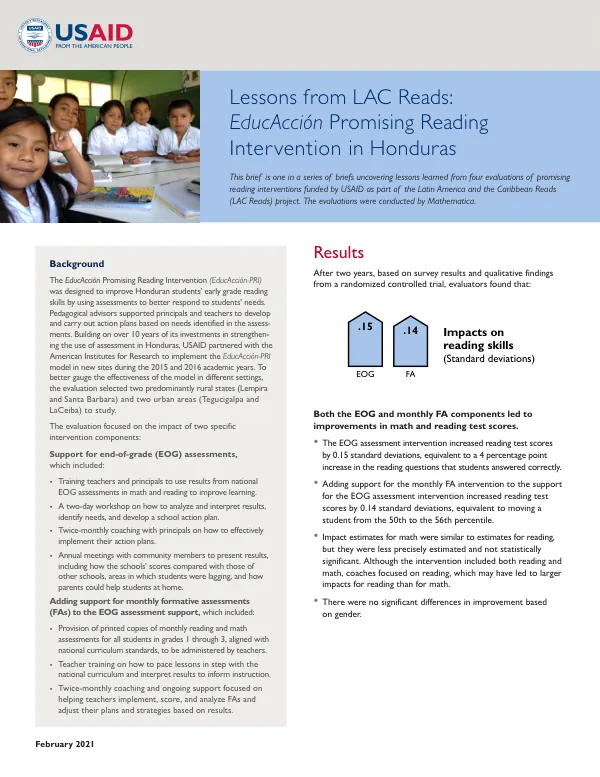
The intervention was implemented in four sites, including two predominantly rural states (Lempira and Santa Barbara) and two urban areas (Tegucigalpa and LaCeiba), during the 2015 and 2016 academic years. The evaluation focused on the impact of two specific intervention components: support for end-of-grade (EOG) assessments and adding support for monthly formative assessments (FAs). The EOG assessment support included training teachers and principals to use results from national EOG assessments in math and reading to improve learning. This support also included a two-day workshop on how to analyze and interpret results, identify needs, and develop a school action plan. Additionally, twice-monthly coaching with principals on how to effectively implement their action plans and annual meetings with community members to present results were provided. The evaluation found that the EOG assessment intervention increased reading test scores by 0.15 standard deviations, equivalent to a 4 percentage point increase in the reading questions that students answered correctly. The monthly FA component included provision of printed copies of monthly reading and math assessments for all students in grades 1 through 3, aligned with national curriculum standards, to be administered by teachers. Teacher training on how to pace lessons in step with the national curriculum and interpret results to inform instruction was also provided. Twice-monthly coaching and ongoing support focused on helping teachers implement, score, and analyze FAs and adjust their plans and strategies based on results. The evaluation found that adding support for the monthly FA intervention to the support for the EOG assessment intervention increased reading test scores by 0.14 standard deviations, equivalent to moving a student from the 50th to the 56th percentile. The evaluation also found that the cost-effectiveness of support to EOG assessments and FAs is $52 and $57, respectively, for increasing learning by 0.1 standard deviations. These interventions fall among the lower cost interventions for similar programs in the Latin America and the Caribbean (LAC) region when compared to findings in a published review of randomized and non-randomized studies of education interventions. The evaluation suggests that policymakers should test the assumptions that support for EOG assessments is more effective in urban areas and FAs are more effective in rural areas in their contexts before implementing at scale. Funders can make these interventions more cost-effective by leveraging existing assessments or integrating the use of assessments and action plans into existing coaching arrangements with principals or teachers. The EducAcción-PRI intervention was implemented as planned, and principals and teachers received the intended materials, training, and support according to their treatment group. The evaluation followed a cohort of students who were enrolled in grade 1 at baseline and in grade 2 when the intervention began. Outcomes of teachers and students in schools assigned to Group A and Group B were compared to estimate the additional impact of the FA intervention, holding constant the impacts of the EOG intervention, which both groups received. The evaluation found that both EOG and monthly formative assessments can change teaching practices and improve learning when coupled with ongoing training and support.
Related documents