THE AMERICAN INSTITUTES FOR RESEARCH
Pedagogical Management Model Based on Proyecto EducAcción's Experience
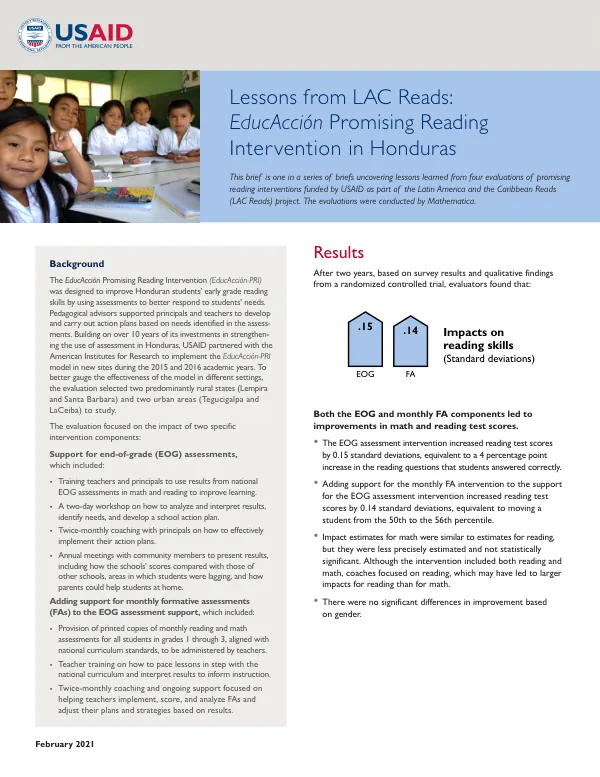
The Pedagogical Management Model Based on Proyecto EducAcción's Experience is a systematization document that aims to document the implementation of technical assistance in participating municipalities, districts, networks, and schools.
2018 · 61 pages
Sign in to readA free account is required to download.
Abstract
The project, funded by the United States Agency for International Development (USAID), was implemented by the American Institutes for Research (AIR) in Honduras since July 2011. The primary objective of the project was to contribute to the achievement of the Education for All (EFA) objectives and strengthen community participation in education. The project was extended in 2015-2016 to provide 120 schools with technical assistance in the use of formative assessment (PFM) and end-of-grade (PFG) test results, known as the Promising Reading Interventions (PRI) component. A third group of 60 schools was classified as Group C, serving as a control group. In 2017, the project received additional funds to implement interventions focused on improving reading proficiency in the 180 schools. The systematization document describes the technical and strategic elements of the technical assistance of the PRI component in the 180 schools. It aims to socialize the achievements and identify the lessons learned in the development of the experience, which can contribute to improving the pedagogical management model in the rest of the country's schools. The pedagogical management model implemented by the project is based on the analysis of relevant theoretical approaches on pedagogical management. The model consists of four components: education administration, normative model, current model, and improved model. The education administration component refers to the conceptual model, which is based on the analysis of relevant theoretical approaches. The normative model is established in national legislation and responds to the curricular and legislative foundations for national curricular development. The current model is the result of the education system's practices, while the improved model is the product of the project's technical assistance. The improved model includes the implementation of technical assistance in the use of formative assessment (PFM) and end-of-grade (PFG) test results, as well as interventions focused on improving reading proficiency. The project's technical assistance was provided to 180 schools, with a focus on improving reading proficiency. The technical assistance included training for teachers and school administrators, as well as the implementation of formative assessment and end-of-grade testing. The project also provided support for the development of a pedagogical management model that could be replicated in other schools. The systematization document provides an overview of the project's implementation, including the methodology used and the results achieved. It also identifies the lessons learned and the challenges faced during the implementation process. The document aims to contribute to the improvement of the pedagogical management model in the rest of the country's schools. The pedagogical management model implemented by the project has several key components, including the use of formative assessment and end-of-grade testing, as well as interventions focused on improving reading proficiency. The model also includes the development of a pedagogical management framework that can be replicated in other schools. The project's technical assistance was provided to 180 schools, with a focus on improving reading proficiency. The project's results show that the technical assistance was effective in improving reading proficiency in the participating schools. The results also indicate that the pedagogical management model implemented by the project can be replicated in other schools, with the potential to improve reading proficiency and overall educational outcomes.