ABT ASSOCIATES
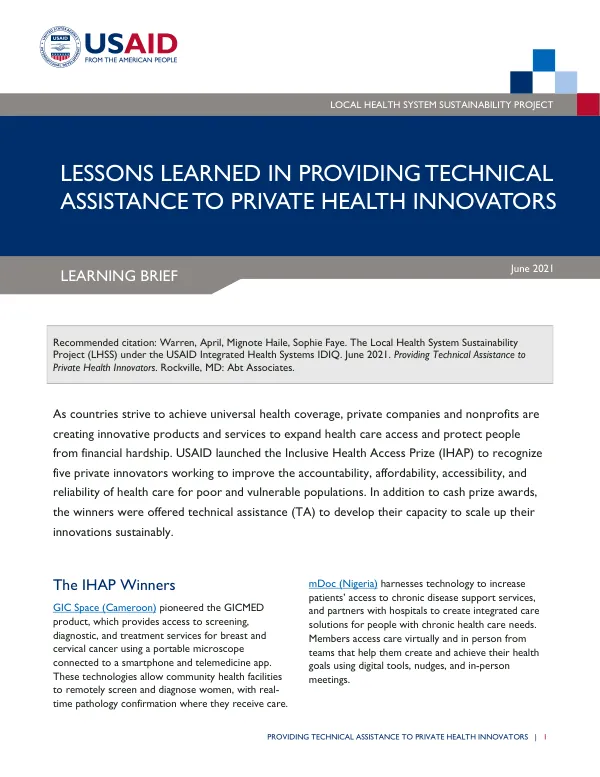
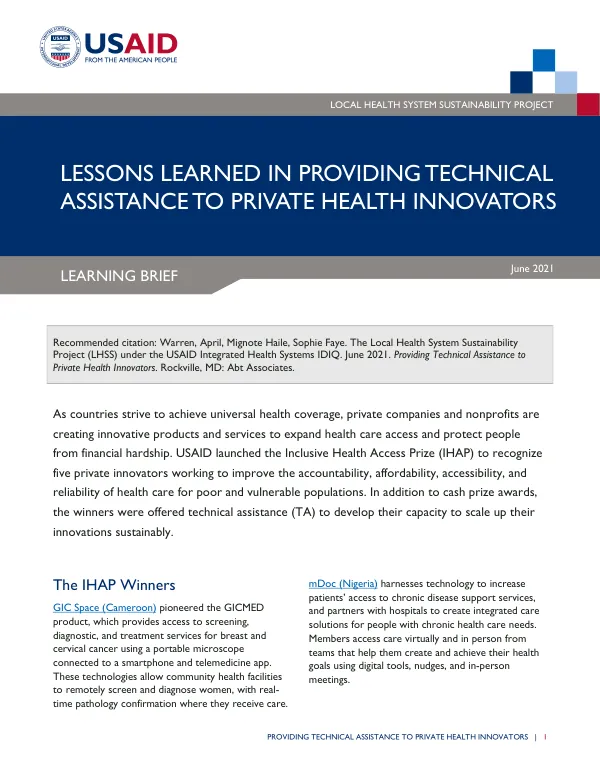
Lessons Learned in Providing Technical Assistance to Private Health Innovators
The Local Health System Sustainability Project, a USAID initiative, provided technical assistance to five private health innovators in 2020-2021.
2021 · 6 pages
Sign in to readA free account is required to download.
Abstract
The winners of the Inclusive Health Access Prize (IHAP) were selected for their innovative products and services aimed at improving health care access and affordability for vulnerable populations. The five winners were GIC Space (Cameroon), mDoc (Nigeria), JokkoSanté (Senegal), Piramal Swasthya Management and Research Institute (India), and Infiuss (Cameroon). The technical assistance (TA) approach was co-designed and participatory, with a focus on strengthening business models and organizational capacities to support scale and financial sustainability. Primary TA needs were identified and validated with the winners, with a focus on business model validation, organizational capacity building, and strategy development. Secondary TA needs were addressed through support delivered to the full cohort of winners, providing opportunities for peer learning and networking. The TA was delivered through in-house experts and local and international partners and consultants from May 2020 to March 2021. The activity embedded a process to capture lessons related to working with local private innovators, including periodic check-ins and facilitated discussions with TA recipients and providers. An anonymous feedback survey was also conducted with the IHAP organizations. The lessons learned from this work highlight the challenges faced by private innovators in scaling and contributing to health system goals, including access to finance, talent gaps, balancing business sustainability and health impact, and limited visibility. The findings also provide insights on how to best design and deliver TA for private health innovators, including the importance of co-designing TA with the winners, addressing primary and secondary TA needs, and providing opportunities for peer learning and networking. The TA outputs and winners' next steps and visions for scale are outlined in Table 1. The table summarizes the primary TA needs and outputs, as well as the winners' visions for scale in five years. The winners' goals and visions for scale include establishing partnerships in new countries, reaching large numbers of people, and integrating diagnostic products to screen for neglected tropical diseases. The Local Health System Sustainability Project's experience with providing technical assistance to private health innovators has provided valuable lessons on how to support innovative health businesses. The findings from this work can be helpful in future efforts to support local private innovators and the health system stakeholders that seek to partner with them.