ABT ASSOCIATES
Lessons Learned in Providing Technical Assistance to Private Health Innovators
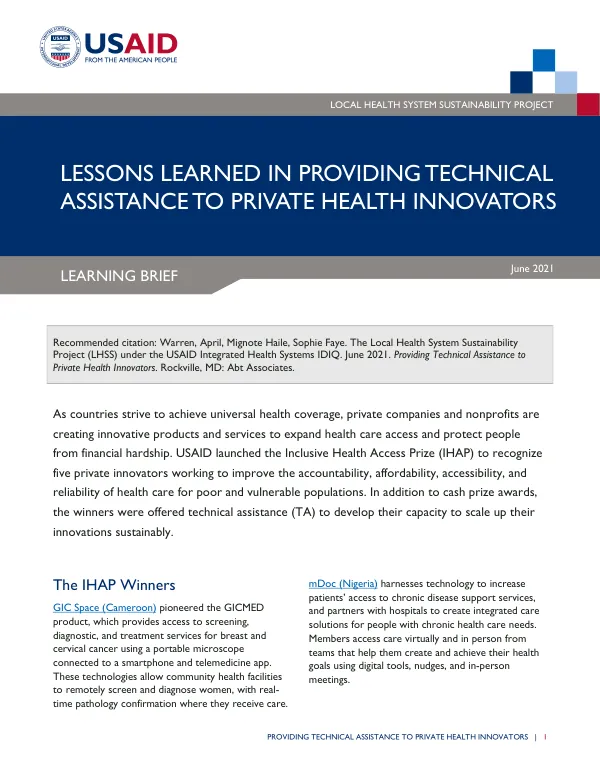
The Local Health System Sustainability Project, a USAID initiative, provided technical assistance to five private health innovators in 2020-2021.
2021 · 6 pages
Sign in to readA free account is required to download.
Abstract
The winners of the Inclusive Health Access Prize (IHAP) were selected for their innovative products and services aimed at improving health care access and affordability for vulnerable populations. The five winners were GIC Space (Cameroon), mDoc (Nigeria), JokkoSanté (Senegal), Piramal Swasthya Management and Research Institute (India), and Infiuss (Cameroon). The technical assistance approach was co-designed and participatory, with a focus on strengthening business models and organizational capacities to support scale and financial sustainability. Primary TA needs were identified and validated with the winners, with a focus on business model validation, organizational capacity building, and strategy development. Secondary TA needs were addressed through support delivered to the full cohort of winners, providing opportunities for peer learning and networking. The TA needs and outputs for each winner are summarized in Table 1. GIC Space aimed to establish partnerships in Ghana, Benin, and the Democratic Republic of Congo, and reach 500,000 women in rural communities. mDoc aimed to reach 1 million additional users by scaling its in-person services through partnerships with public and private health facilities in Nigeria, Ghana, and South Africa. JokkoSanté aimed to explore and test different customer segments for their innovative technology platform, intending to reach at least 3 million people. Piramal Swasthya aimed to transform the lives of 54 million people, of whom 20 million will be tribal people, through the Tribal Health Collaborative. Infiuss aimed to expand operations to serve 100,000 people across West Africa and set up their own blood testing facility to reduce costs for patients. Lessons learned from the TA provision include the importance of addressing access to finance, talent gaps, and balancing business sustainability and health impact. Private health innovators face challenges in scaling and contributing to health system goals, including limited access to finance, talent gaps, and limited visibility among government ministries and regulatory bodies. Supporters can best design and deliver TA for private health innovators by providing access to finance, building organizational capacity, and facilitating partnerships with government ministries and regulatory bodies. The Local Health System Sustainability Project highlights the importance of supporting local private innovators in achieving health system goals. By providing technical assistance and addressing the challenges faced by private health innovators, the project demonstrates the potential for innovative solutions to improve health care access and affordability for vulnerable populations.