USAID DEC
Lessons Learned: Integrating Gender Equality and Social Inclusion into Customary Land Documentation in Malawi
Sign inTETRA TECH
Lessons Learned: Integrating Gender Equality and Social Inclusion into Customary Land Documentation in Malawi
The Government of Malawi enacted a series of land laws in 2016, including the Customary Land Act, which allows customary land holders to formalize ownership by registering their parcels.
2023 · 18 pages
Sign in to readA free account is required to download.
Abstract
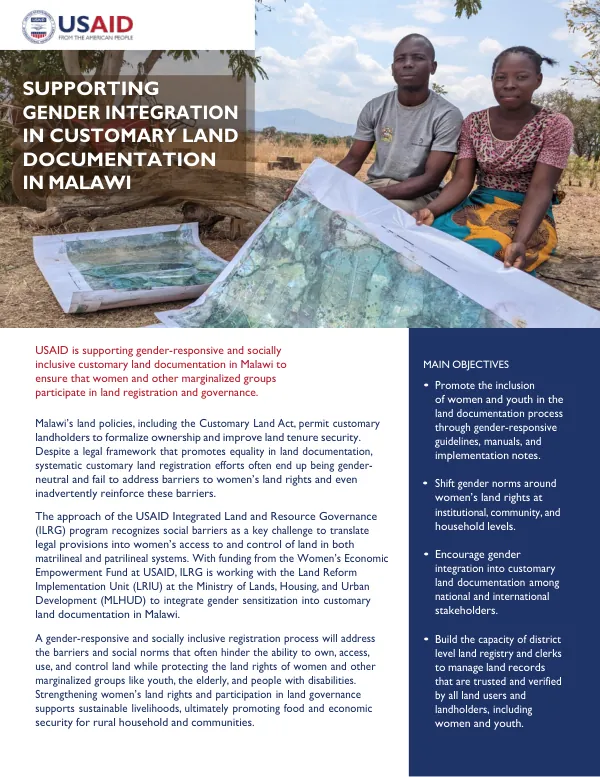
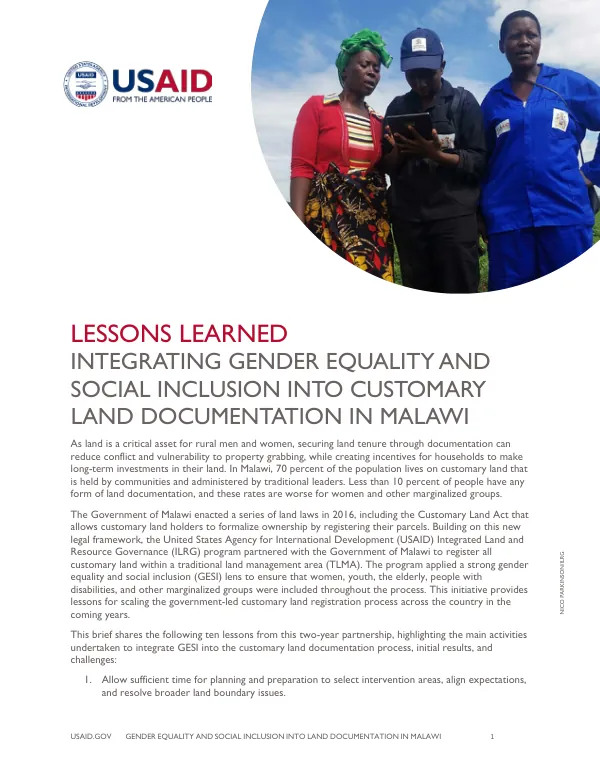
Building on this legal framework, the United States Agency for International Development (USAID) Integrated Land and Resource Governance (ILRG) program partnered with the Government of Malawi to register customary land within a traditional land management area (TLMA). The program applied a strong gender equality and social inclusion (GESI) lens to ensure that women, the elderly, people with disabilities, and other marginalized groups were included throughout the process. The initiative aimed to document customary land in one TLMA in a gender-responsive and inclusive manner, issue certificates for approximately 10,000 land parcels, and influence the government of Malawi, other funders, and stakeholders to build support for GESI-responsive land registration. The program selected TA Mwansambo in Nkhotakota district as the jurisdiction, which has an estimated population of 46,000 people organized under 23 group village headpersons (GVHs) across 23,000 hectares in the central region of the country. The TA is a predominantly Chewa matrilineal area where a matrilocal marriage system had been historically practiced. However, due to social and economic changes, the predominant form of marriage has shifted to chitengwa, a patrilocal system in which a woman moves to her husband's village after marriage. This shift has led to land being considered the property of men, and women are perceived as outsiders with limited rights to own or make decisions about land. The program faced challenges in getting buy-in from stakeholders about the importance of a gender-responsive approach to land registration. Some stakeholders were concerned that GESI investment was not needed because the legal framework is inclusive, but this was addressed by emphasizing that even when laws are non-discriminatory, women and other marginalized groups still face social barriers to exercising their land rights. The program conducted a robust gender assessment in TA Mwansambo, which identified barriers and opportunities to support gender equality in land registration and governance. The assessment found that although the normative legal framework supports gender equality in land ownership, customary land governance leaves potential for ambiguity that can be detrimental to women and other marginalized groups. The program also faced a challenge in rushing towards household documentation without fully addressing long-standing land use challenges and boundary conflicts between TAs. Despite having a preparation period, these issues were not resolved before household documentation started, which slowed progress. At the end of the program, all stakeholders agreed that clarifying TA boundaries and other land use challenges should happen before household documentation starts. The ILRG program learned several lessons from this initiative, including the importance of allowing sufficient time for planning and preparation to select intervention areas, align expectations, and resolve broader land boundary issues. The program also learned the importance of carrying out a robust gender assessment to inform GESI-specific and GESI integration in the land registration process. The program's findings and lessons learned can inform the scaling of the government's customary land registration process across the country. The initiative provides a model for integrating GESI into customary land documentation, which can help to address the persistent resistance to registering land in the name of women in patrilocal marriage systems. The program's success in promoting GESI in customary land registration and governance can be attributed to its focus on shifting harmful social norms at the household and community levels. The program also built support and resources for land dispute resolution and created space for long-term change.
Related documents