TETRA TECH
Lessons Learned: Private Sector Engagement on Land & Gender
Private sector engagement is a key strategy for the United States Agency for International Development (USAID).
2023 · 40 pages
Sign in to readA free account is required to download.
Abstract
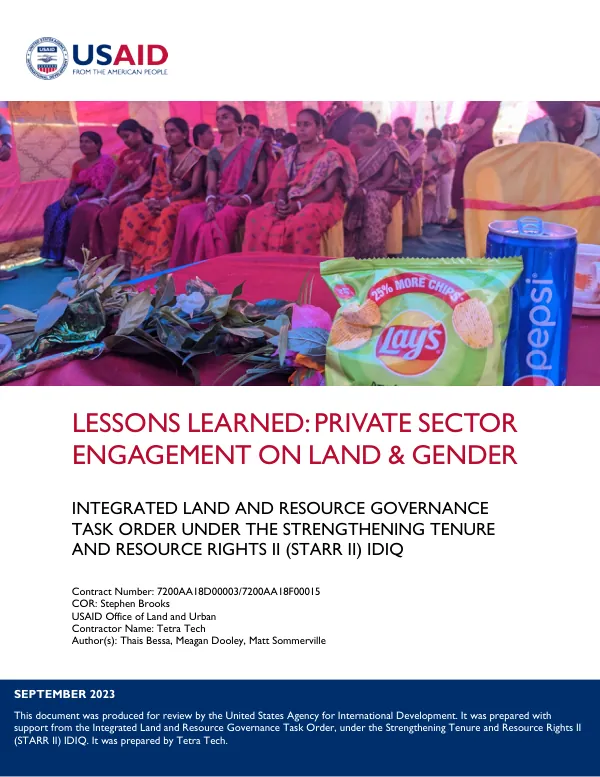
Under this approach, USAID consults, strategizes, aligns, collaborates, and implements with the private sector to leverage US government investments for greater scale, sustainability, and effectiveness. This brief explores USAID experiences partnering with the private sector to advance land tenure security and gender equality and women's empowerment across five countries under the Integrated Land and Resource Governance (ILRG) activity (2018-2023). Public-private partnerships (PPPs) are a key element of private sector engagement. USAID defines PPPs as an arrangement between public and private sector entities to share risks and rewards in the delivery of services and infrastructure. PPPs are an opportunity to leverage resources, mobilize industry expertise and networks, and bring fresh ideas to projects. The catalytic role of the private sector is well recognized in agricultural production, contributing significantly to input delivery, storage and processing, transport, transfer of technical competencies to producers, and sale of commodities to national and international markets. However, partnerships with the private sector on broader development goals, such as land tenure security or women's empowerment, require significant effort to align visions, interventions, and outcomes. For example, some broad public-private partnerships have promoted policy and legal reforms around land governance to improve the business enabling environment, the enforceability of commercial land rights, and land markets. Companies working in the agriculture sector may be wary of getting involved in policy issues around land tenure reform, which they see as outside of their core business interest. Women's empowerment is often an easier entry point for private sector engagement, but many private sector efforts are confined to corporate social responsibility (CSR) initiatives, rather than fully integrated into commercial supply chain operations. Many private sector entities may not have the capacity or willingness to engage in more complex development issues. Despite these challenges, USAID has made significant progress in partnering with the private sector to advance land tenure security and gender equality and women's empowerment. The ILRG activity has demonstrated the potential for private sector engagement to drive positive change in land governance and women's empowerment. Through partnerships with private sector companies, USAID has been able to leverage resources, expertise, and networks to support the development of more inclusive and equitable land governance systems. These partnerships have also helped to promote women's economic empowerment by providing training and capacity-building opportunities for women in the agriculture sector. The ILRG activity has also highlighted the importance of aligning partner interests, managing different time horizons, and building trust with other stakeholders. Effective partnerships require a deep understanding of the needs and priorities of all stakeholders, as well as a willingness to adapt and evolve over time. By building trust and fostering a collaborative approach, USAID has been able to leverage the expertise and resources of the private sector to drive positive change in land governance and women's empowerment. In conclusion, private sector engagement is a critical component of USAID's development strategy. Through partnerships with private sector companies, USAID has been able to leverage resources, expertise, and networks to support the development of more inclusive and equitable land governance systems. The ILRG activity has demonstrated the potential for private sector engagement to drive positive change in land governance and women's empowerment, and has highlighted the importance of aligning partner interests, managing different time horizons, and building trust with other stakeholders.