USAID
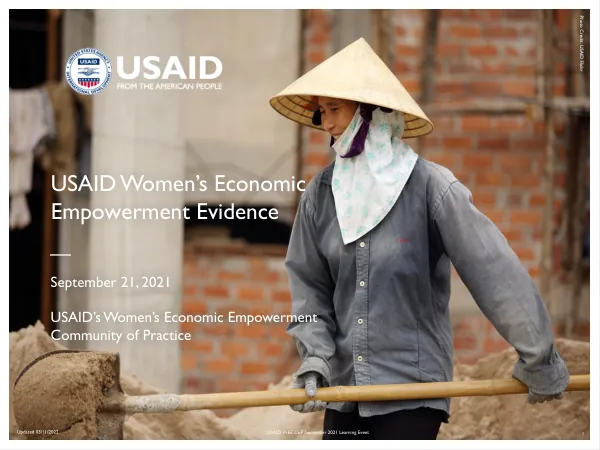
USAID Women’s Economic Empowerment Evidence
The Women's Economic Empowerment Evidence initiative is a community of practice established by USAID to gather and share evidence on women's economic empowerment.
2021 · 34 pages
Sign in to readA free account is required to download.
Abstract
The initiative aims to address data gaps and disseminate knowledge products to facilitate learning among members and foster engagement opportunities. The community comprises three tiers: USAID staff, implementing partners receiving direct funding from USAID GenDev Tier 1, USAID staff interested in learning more about gender equality and WEE that do not receive direct funding from USAID GenDev, private sector companies, networks, associations, and the wider donor and development community interested in gender equality and WEE. The community focuses on three key areas: shifting social norms to support and increase women's economic power and gender equality, building capacity to develop, reform, implement, and enforce governmental policies, laws, and regulations as well as internal organizational and business policies, and mitigating gender-based violence and harmful behaviors that reduce women's safety and ability to participate in and benefit from the economy. The community seeks to identify proven and evidence-based existing approaches that governments, private sector entities, civil society organizations, and societies are using to address these challenges. Three landscaping studies have been conducted to identify and assess existing interventions and available evidence. These studies aim to provide actionable findings and recommendations to strengthen the results of activities to increase women's economic access, agency, and power, and to identify key gaps in evidence to be addressed that will accelerate women's economic empowerment. The studies use evidence ranking criteria to evaluate the strength of evidence, including proven, good, and promising interventions. The landscaping studies have identified several proven interventions to shift social norms, including gender transformative approaches combined with economic development interventions, household methodologies combined with facilitated dialogue, critical reflection, and goal setting, group-based collective action and learning, male engagement through entry points that appeal to men's self-interest and positive masculinities, and gender analysis and norms diagnostics to identify and assess the strength of norms and ways of facilitating positive shifts. These interventions have been identified as effective in increasing women's economic power and gender equality. The community of practice also focuses on building capacity to develop, reform, implement, and enforce governmental policies, laws, and regulations as well as internal organizational and business policies. This includes identifying key gaps in evidence to be addressed that will accelerate women's economic empowerment. The community seeks to provide actionable findings and recommendations to strengthen the results of activities to increase women's economic access, agency, and power. In addition, the community of practice aims to mitigate gender-based violence and harmful behaviors that reduce women's safety and ability to participate in and benefit from the economy. This includes identifying proven and evidence-based existing approaches that governments, private sector entities, civil society organizations, and societies are using to address these challenges. The community seeks to provide actionable findings and recommendations to strengthen the results of activities to increase women's economic access, agency, and power, and to identify key gaps in evidence to be addressed that will accelerate women's economic empowerment. The community of practice uses a three-tier approach to engage members and foster engagement opportunities. The tiers include USAID staff, implementing partners receiving direct funding from USAID GenDev Tier 1, USAID staff interested in learning more about gender equality and WEE that do not receive direct funding from USAID GenDev, private sector companies, networks, associations, and the wider donor and development community interested in gender equality and WEE. The community seeks to provide a platform for collective learning and action to address the challenges of women's economic empowerment.