USAID DEC
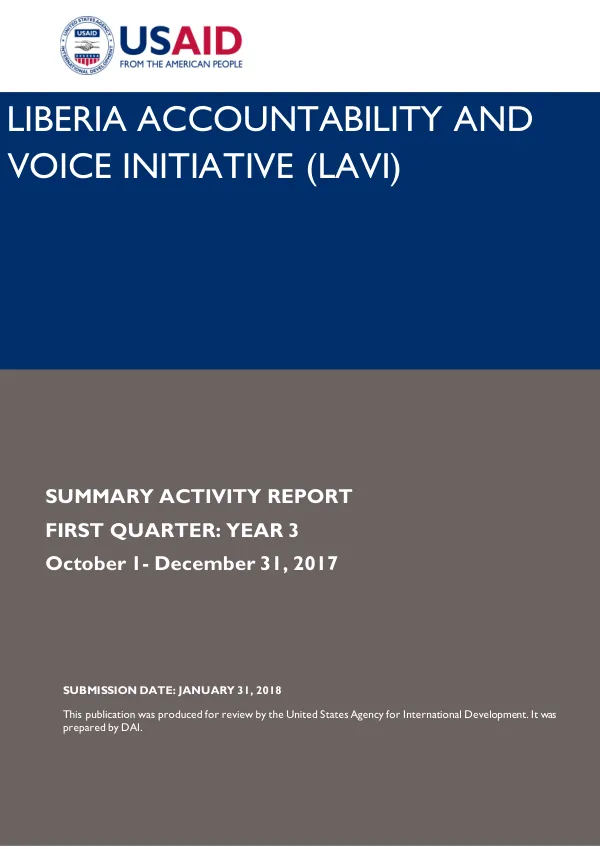
Liberia Accountability and Voice Initiative (LAVI) Quarterly Report FY2018 Quarter 1: October 1 to December 31, 2017
Sign inDAI GLOBAL, LLC
Liberia Accountability and Voice Initiative (LAVI) Quarterly Report FY2018 Quarter 1: October 1 to December 31, 2017
Liberia Accountability and Voice Initiative (LAVI) is a five-year program funded by the United States Agency for International Development (USAID) with a total budget of $17 million.
2018 · 136 pages
Sign in to readA free account is required to download.
Abstract
The program was awarded to DAI Global, LLC on November 25, 2015, with the primary objective of strengthening multi-stakeholder partnerships to advocate for and monitor policy and accountability reforms in Liberia. The program contributes to USAID/Liberia's Country Development Cooperation Strategy (CDCS) for more effective, accountable, and inclusive governance. The LAVI project has four objectives, which are designed to work collectively towards achieving the overall goal of contributing to USAID's development objective of "a more effective, accountable, and inclusive Government." The four objectives are: (1) Strengthen Horizontal and Vertical Linkages among Actors Engaged in Similar Issues, (2) Increase Organizational Capacity of Targeted CSOs to Participate in Issue-Based Reforms, (3) Promote the Development of Ongoing Capacity Development Services on the Local Market, and (4) Ensure that Learning and Methodologies Are Shared and Applied by Other Development Actors. During the first quarter of Year 3 (October 1 to December 31, 2017), the LAVI project made significant progress in achieving its objectives. In terms of Objective 1, the project continued to make a meaningful impact regarding citizens' engagement in the management of County Social Development Funds (CSDF). Citizens made use of knowledge gained in advocacy workshops and Inclusive Citizens and Compliance Monitoring (ICCM) trainings to demonstrate the use of community score cards, stakeholders' signatures tracking on pledge cards, and fact sheets utilization during advocacy. Citizens were able to use methods of influencing and reporting to their legislators and local government on CSDF issues. Five of the USAID LAVI-supported Natural Resources Management (NRM) Coalition Partners conducted a total of 155 activities during the quarter under review. These activities included technical support to NRM Coalition CSO partners and government partners, selection of CSO Coalition partners and coalition building for Education Thematic Window, and engagement and support to government entities. The NRM Coalition Capacity Development Activities also made significant progress, with a total of 25 capacity assessments conducted for CSO partners. The LAVI project also made progress in increasing the organizational capacity of targeted CSOs to participate in issue-based reforms. Capacity assessments were conducted for Education CSO partners, and a total of 15 capacity development activities were implemented. The project also provided technical assistance to service providers, with a total of 10 short-term technical assistance (STTA) activities conducted. In terms of promoting the development of ongoing capacity development services on the local market, the LAVI project made significant progress. A total of 10 service provider quality control measures were implemented, and a total of 5 service provider pool sustainability support activities were conducted. The project also provided technical assistance to service providers, with a total of 10 STTA activities conducted. Finally, the LAVI project made progress in ensuring that learning and methodologies are shared and applied by other development actors. A total of 5 knowledge management and learning (KM&L) activities were conducted, and a total of 10 results framework (RF) activities were implemented. The project also conducted a total of 5 quarterly performance reviews (QPR) and a total of 10 results framework (RF) activities. Overall, the LAVI project made significant progress in achieving its objectives during the first quarter of Year 3. The project's activities and results demonstrate its commitment to strengthening multi-stakeholder partnerships, increasing organizational capacity, promoting capacity development services, and sharing learning and methodologies with other development actors.