USAID DEC
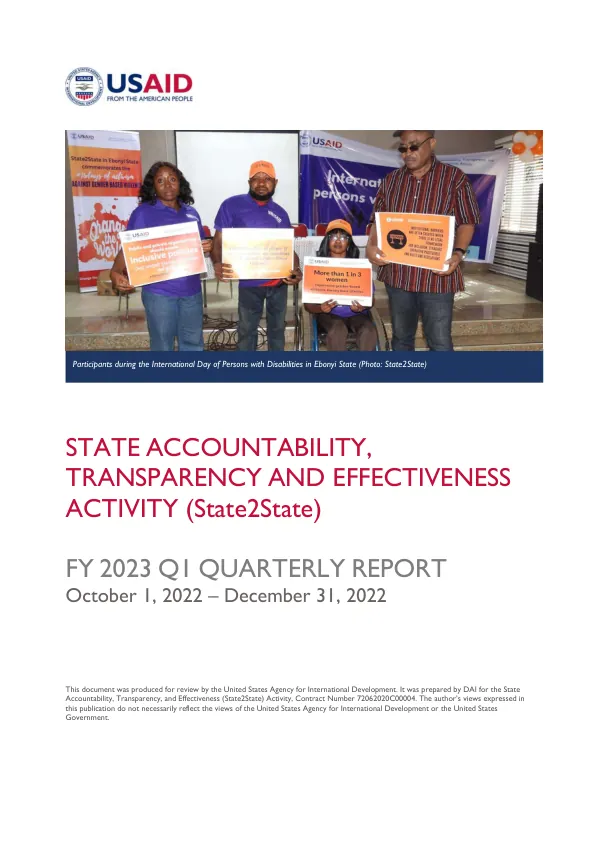
State Accountability, Transparency and Effectiveness Activity (State2State) FY 2023 Q1 Quarterly Report
Sign inDAI GLOBAL, LLC
State Accountability, Transparency and Effectiveness Activity (State2State) FY 2023 Q1 Quarterly Report
The State Accountability, Transparency, and Effectiveness Activity (State2State) is a USAID-funded program aimed at improving the efficiency and responsiveness of sub-national government operations in Nigeria.
2023 · 159 pages
Sign in to readA free account is required to download.
Abstract
The program operates in six target states: Adamawa, Akwa Ibom, Bauchi, Ebonyi, Gombe, and Sokoto. State2State's primary objectives are to increase the efficiency of sub-national government operations, improve sub-national government responsiveness to citizen needs, and enhance sub-national capacity to manage conflict. State2State's implementation progress during the first quarter of Year 3 (October 1, 2022 - December 31, 2022) was promising overall. The program continued to build on the visible buy-in and support from state government leaders and civil society stakeholders to deliver project activities and technical assistance across the partner states. State2State has seen improvements in budgets and releases for the priority sectors of education, health, and water, sanitation, and hygiene (WASH) in the six states. The program's objective 1, which focuses on increasing the efficiency of sub-national government operations, has made significant progress. State2State has conducted budget planning, administration, and execution activities in all six states, resulting in improved budget transparency and internal controls. The program has also implemented procurement reforms, domestic resource mobilization, and monitoring and evaluation by state institutions. State2State's objective 2, which aims to improve sub-national government responsiveness to citizen needs, has also made notable progress. The program has improved state responsiveness to citizens through the implementation of citizen engagement and participatory planning policy (CEPP) and the establishment of community-based organizations (CBOs). State2State has also engaged with civil society organizations (CSOs) to promote transparency and accountability in government operations. The program's objective 3, which focuses on improving sub-national capacity to manage conflict, has also seen significant progress. State2State has conducted conflict mitigation skills training for state officials and has established a conflict assessment framework (CAF) to identify and address potential conflict areas. The program has also implemented interventions to mitigate conflict in the Bauchi State WASH sector. State2State has also made progress in its cross-cutting interventions, including monitoring, evaluation, and learning (MEL), capacity building, communications, gender equality and social inclusion, and collaboration with other USAID implementing partners and donors. The program has conducted training sessions for state officials and has established a social media presence to promote its activities and engage with stakeholders. In terms of management and administration, State2State has made progress in office accommodations and renovations, human resources, subcontracting, procurement, security, and implementation challenges and opportunities. The program has also responded to comments from the Contracting Officer's Representative (COR) on its last quarterly report. Overall, State2State's first quarter of Year 3 has been promising, with significant progress made in all areas of the program. The program continues to build on its successes and is well-positioned to achieve its objectives in the coming quarters.