USAID DEC
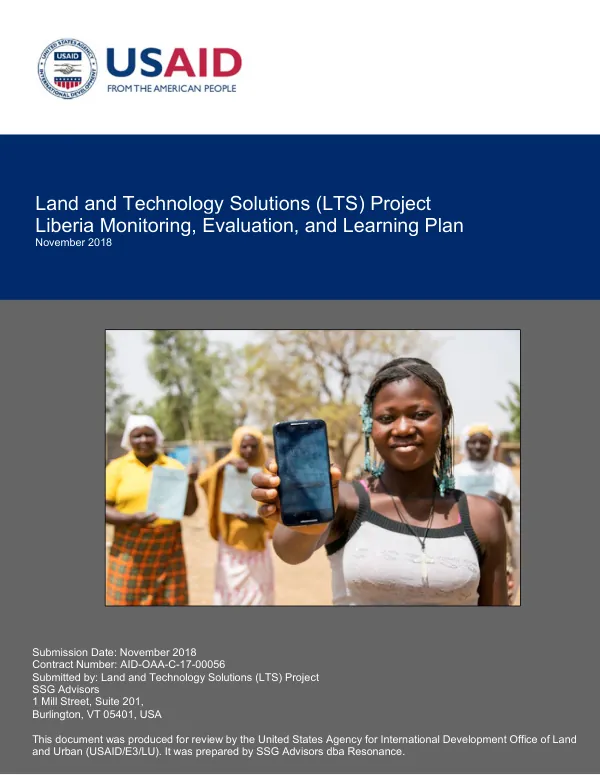
Liberia Monitoring, Evaluation, and Learning Plan for the Land and Technology Solutions (LTS) Project
Sign inSSG ADVISORS, LLC
Liberia Monitoring, Evaluation, and Learning Plan for the Land and Technology Solutions (LTS) Project
The Land Technology Solutions (LTS) Project, a pilot project initiated in Liberia's Blei Community Forest, aims to improve land and resources governance through the use of mobile technology.
2018 · 14 pages
Sign in to readA free account is required to download.
Abstract
The project, led by SSG Advisors, seeks to document land rights effectively and efficiently, enabling host-country stakeholders to satisfy the objectives of the LTS project. The LTS project has several key objectives, including creating land technology tools and resources, supporting rapid assessments to determine the feasibility of utilizing Mobile Applications to Secure Tenure (MAST), creating and adapting technologies to the country context, piloting MAST, and creating evidence and documentation for scaling. MAST is a suite of innovative technology and inclusive methods that use mobile phones and tablets to map and document land and resource rights. The pilot project will be conducted in and around the Blei Community Forest, a conservation area in Northern Nimba county, Liberia. The forest is jointly managed by the Gba and Zor communities, consisting of 40 villages, including 16 villages from the Zor Community Forest and 18 villages from the Gba Community Forest. The project aims to collect, consolidate, and disseminate geospatial and attribute data on community and farm boundaries, resource inventory, ownership claims, and other items. The project will also focus on building an understanding among beneficiaries of community lands and forest development, generating economic benefits, and safeguarding the forest. The LTS project proposes to collect forest monitoring data and develop a Community Forest Management Plan (CFMP) to prescribe rules and regulations for the forest's management. The project's performance monitoring plan includes several indicators, including the number of hectares captured by the MAST system, the number of beneficiaries as a result of the LTS MAST intervention, and the percentage of landholders expressing interest in adopting improved farming or conservation practices after participating in the approach. The project will also conduct surveys at baseline and end-of-pilot to track a range of information, including sex, education level, and education level. The LTS project has a strong focus on community engagement and participation, with the Community Forest Management Board (CFMB) playing a key role in the planning process. The CFMB is a management board comprised of 12 members, working with the Community Assembly (CA), a larger participatory body consisting of 80 persons. The Executive Committee, consisting of 10 persons, has oversight responsibilities over the CFMB and decides on policies and strategic direction. The project's approach is expected to have a positive impact on the community, with the potential to improve land governance, improve land governance, and increase economic benefits for the community. The LTS project is expected to contribute to the learning agenda, providing evidence and documentation for scaling, and informing future projects and initiatives.
Related documents