LINKAGES
LINKAGES Quarterly Report (April 1 – June 30, 2017) – Thailand
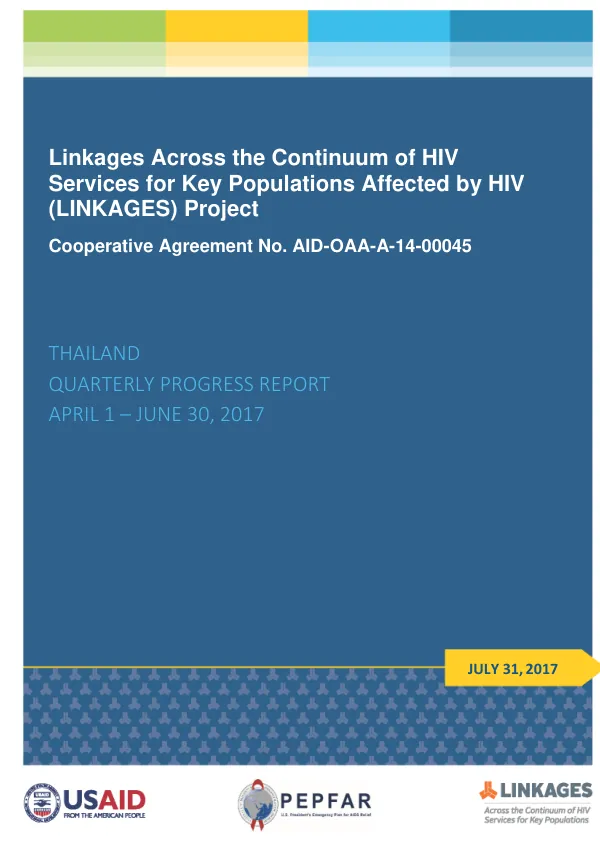
The LINKAGES Thailand project continued close collaboration and engagement with its local implementing partners to provide combination HIV prevention, care, and treatment services among members of key populations, including men who have sex with men, male sex workers, transgender women, transgender sex workers, and female sex workers in priority provinces.
2017 · 61 pages
Sign in to readA free account is required to download.
Abstract
During the reporting period, LINKAGES reached a total of 18,285 key populations with HIV prevention services, including 10,979 men who have sex with men, 2,547 male sex workers, 2,290 transgender women, 504 transgender sex workers, and 1,965 female sex workers. The project achieved its highest level of prevention program coverage since its inception, with a 21% increase over the previous quarter. This was driven primarily by performance at MPlus and Caremat, which reported significant increases in program coverage due to new online-to-offline activity models. However, the majority of community partners actually reported decreased prevention coverage in FY17 Q3, particularly those serving primarily sex worker populations, which have been subject to a government crackdown on sex work activities. During the reporting period, 707 men who have sex with men, 13 male sex workers, 18 transgender women, and 9 transgender sex workers were initiated on pre-exposure prophylaxis (PrEP). The project also provided HIV testing and provided results to 7,152 men who have sex with men, 423 male sex workers, 766 transgender women, 84 transgender sex workers, and 215 female sex workers. Of these, 398 men who have sex with men, 68 male sex workers, 60 transgender women, and 15 transgender sex workers tested HIV-positive. The project also reported significant progress in treatment coverage, with 398 men who have sex with men, 68 male sex workers, 60 transgender women, and 15 transgender sex workers newly initiated on antiretroviral therapy (ART). As of the end of FY17 Q3, there were 1,357 men who have sex with men, 97 male sex workers, 92 transgender women, 27 transgender sex workers, 2 female sex workers, and 6 people who inject drugs actively receiving ART. The main challenge in this reporting period is the low treatment coverage vis-à-vis targets. The chief barrier to achieving treatment targets remains that a high percentage of clients are provided treatment services at facilities not affiliated with the LINKAGES project, and not reporting data on service delivery. The project has identified the priority ART providers in each implementing site and has begun providing technical assistance to these sites, including training on stigma and discrimination, management of ART and hormones for transgender clients, and establishing Facebook groups with ART clinicians to allow for ongoing delivery of updated technical information. The project also reported significant progress in operational research on HIV oral fluid screening, which was fully implemented and achieved nearly 90% of the anticipated sample size for community-based service delivery. Additionally, the project launched a number of new digital tools, including eCascade View, a web-based dashboard for visualizing and tracking the HIV service delivery cascade in real time, and an online reservations system to track uptake of HIV testing and counseling services.
Related documents
Documents in this collection
 2019
2019USAID DEC
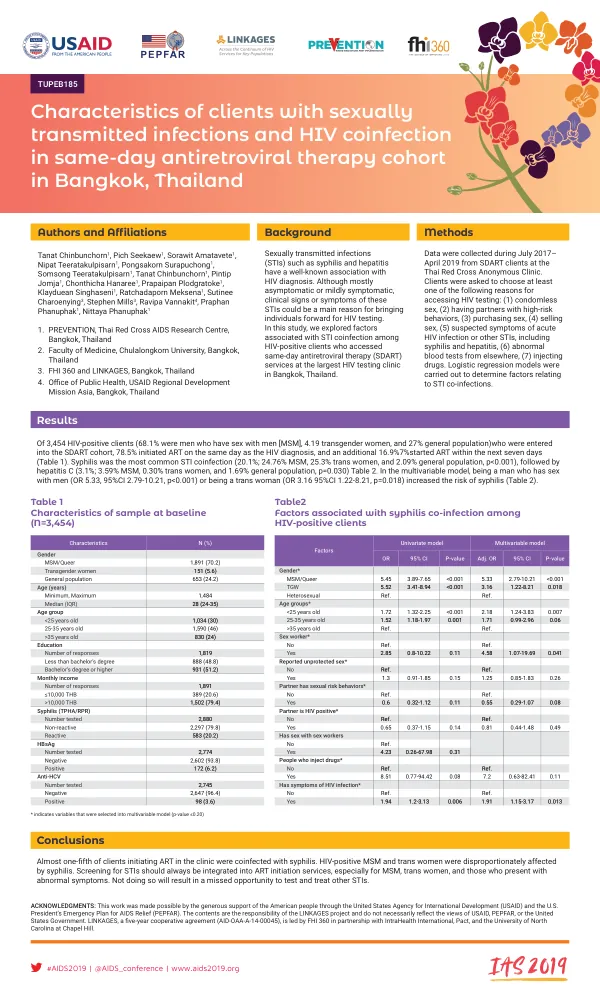
Characteristics of clients with sexually transmitted infections and HIV coinfection in same-day antiretroviral therapy cohort in Bangkok, Thailand
Open record 2023
2023USAID DEC