USAID DEC
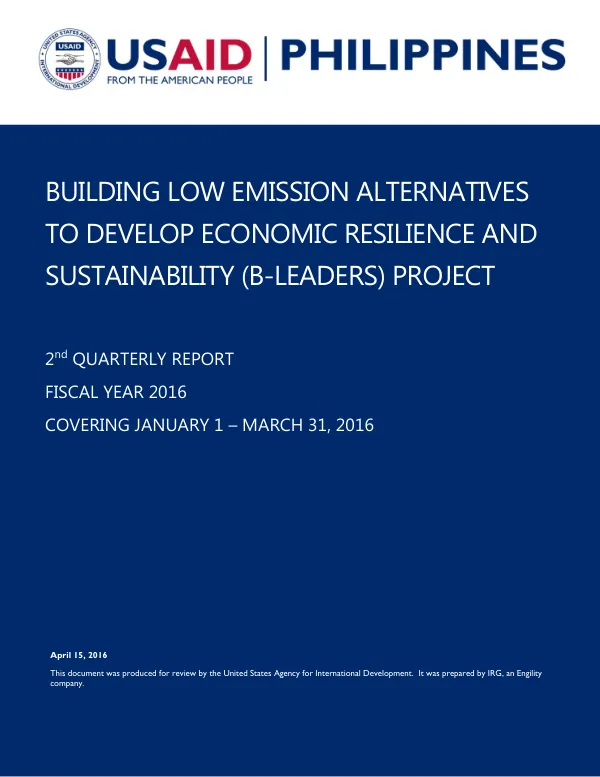
Building Low Emission Alternatives to Develop Economic Resilience and Sustainability 3rd Quarterly Report
Sign inUSAID
Building Low Emission Alternatives to Develop Economic Resilience and Sustainability 3rd Quarterly Report
The Building Low Emission Alternatives to Develop Economic Resilience and Sustainability (B-LEADERS) project is a USAID-funded initiative aimed at promoting low emission development strategies in the Philippines.
2016 · 42 pages
Sign in to readA free account is required to download.
Abstract
The project's primary objective is to support the country's Nationally Determined Contribution (NDC) under the Paris Agreement, which aims to reduce greenhouse gas emissions by 70% by 2030. The project's scope encompasses several key areas, including capacity building for low emission development, investments in clean energy projects, and the development of cities through the Cities Development Initiative (CDI). The CDI focuses on supporting local governments in developing sustainable urban planning and infrastructure, with a particular emphasis on reducing greenhouse gas emissions. The project's implementation is guided by a logical framework, which outlines the expected results and indicators for measuring progress. The framework is structured around three main tasks: strengthening capacity for low emission development, increasing investments in clean energy projects, and developing cities through the CDI. As of the 3rd quarter of Fiscal Year 2016, the project has made significant progress in achieving its objectives. The capacity building component has resulted in the strengthening of in-country capacity for low emission development, with over 2,000 participants trained in various aspects of low emission development. The clean energy component has seen an increase in investments, with over $10 million leveraged from various sources, including the private sector and international organizations. The CDI has also made notable progress, with several cities participating in the initiative and demonstrating significant reductions in greenhouse gas emissions. The project has also facilitated the development of renewable energy projects, including a 10-megawatt solar power plant in the province of Batangas. In terms of cross-cutting issues, the project has made significant progress in promoting gender equality and women's empowerment, with a focus on increasing the participation of women in decision-making processes related to low emission development. The project has also facilitated the development of public-private partnerships, with several partnerships established between the government and the private sector to support low emission development initiatives. The project's midterm evaluation has shown promising results, with a 27% increase in household income among project participants compared to the control group. The evaluation has also highlighted the importance of integrating low emission development strategies into national and local development plans. The project's planned activities for the next quarter include the launch of a new initiative to support the development of renewable energy projects in the Philippines, as well as the conduct of a series of training programs for local government officials on low emission development. The project will also continue to support the development of cities through the CDI, with a focus on reducing greenhouse gas emissions and promoting sustainable urban planning and infrastructure. Overall, the B-LEADERS project has made significant progress in achieving its objectives, with a focus on promoting low emission development strategies in the Philippines. The project's success has been attributed to its strong partnerships with local governments, the private sector, and international organizations, as well as its commitment to promoting gender equality and women's empowerment.