USAID DEC
Long-Acting and Permanent Methods Community of Practice Mobile Services Working Group Meeting
Sign inENGENDERHEALTH
Long-Acting and Permanent Methods Community of Practice Mobile Services Working Group Meeting
Mobile outreach services have been identified as an important family planning service delivery strategy, with anecdotal evidence suggesting their effectiveness in delivering long-acting and permanent methods (LA/PMs).
2011 · 8 pages
Sign in to readA free account is required to download.
Abstract
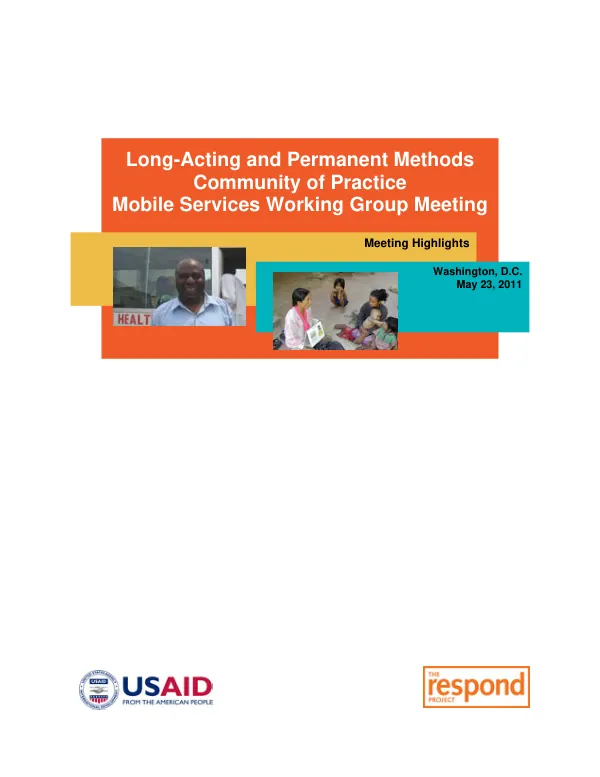
However, limited information exists about the relative effectiveness or cost of various service models. Several studies are planned or underway to document or evaluate outreach models under the RESPOND Project and the Support for International Family Planning Organizations (SIFPO) initiative. The RESPOND Project and the U.S. Agency for International Development (USAID) co-chaired the Mobile Services Working Group meeting, held on May 23, 2011, in Washington, D.C. The meeting objectives were to compare research and evaluation methodologies and tools, share preliminary findings, and exchange information regarding current and future research. Technical presentations featured various organizations, including Marie Stopes International (MSI), Futures Institute, and FHI. MSI's mobile services initiatives were presented by Nomi Fuchs-Montgomery, who highlighted the organization's emphasis on providing methods not available in public-sector facilities, especially LA/PMs, and individual and group counseling. Fuchs-Montgomery emphasized the need for an evidence base to support mobile services, as anecdotal evidence and experience indicate their effectiveness but may not be rigorous enough to call them a high-impact practice (HIP). The presentation sparked a plenary discussion, with participants raising questions about the number of procedures that outreach providers can perform per day and MSI's emphasis on new FP users as their target population. A proposed area for future exploration is assessing "intention switching" rather than focus on method switching, as women progress in their life cycle and their reproductive intentions evolve. William Winfrey of Futures Institute delivered a presentation on the costing of MSI FP activities, introducing a tool developed to provide costing data to MSI country program managers. The tool presents costs disaggregated by delivery channel, FP method, and component, and is currently being piloted. However, the tool is designed for use by MSI country programs and is not likely applicable to other groups. Adrienne Testa of MSI delivered a presentation on MSI mobile services, highlighting the organization's efforts to strengthen the evidence base for service delivery. MSI has found that female sterilization comprised 53% of all couple-years of protection (CYPs) delivered through mobile services. The presentation sparked a plenary discussion, with participants raising questions about the tool's limitations and the need for further research. The meeting co-chairs, Patricia MacDonald and Marguerite Farrell, emphasized the importance of contributing to the body of evidence on mobile services, as much of the research is dated. Key questions remain to be answered, including the best mobile service delivery approaches, what clients want, and how to best program to meet their needs. The meeting highlighted the need for further research and evaluation to support the scale-up of mobile services.
Related documents