TETRA TECH
Uganda Climate Change Vulnerability Assessment
Uganda's agricultural households face significant challenges due to a deteriorating natural resource base, eroding ecosystem services, and reduced access to land.
2012 · 6 pages
Sign in to readA free account is required to download.
Abstract
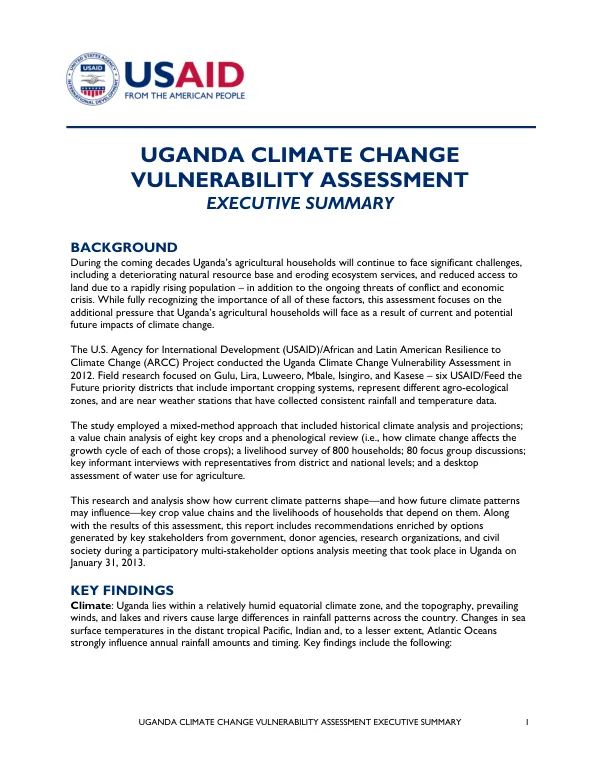
The ongoing threats of conflict and economic crisis exacerbate these challenges. This assessment focuses on the additional pressure that Uganda's agricultural households will face as a result of current and potential future impacts of climate change. The U.S. Agency for International Development (USAID)/African and Latin American Resilience to Climate Change (ARCC) Project conducted the Uganda Climate Change Vulnerability Assessment in 2012. Field research focused on six USAID/Feed the Future priority districts, including Gulu, Lira, Luweero, Mbale, Isingiro, and Kasese. These districts represent different agro-ecological zones and are near weather stations that have collected consistent rainfall and temperature data. The study employed a mixed-method approach that included historical climate analysis and projections, a value chain analysis of eight key crops, a phenological review, a livelihood survey of 800 households, 80 focus group discussions, key informant interviews, and a desktop assessment of water use for agriculture. The research and analysis show how current climate patterns shape and how future climate patterns may influence key crop value chains and the livelihoods of households that depend on them. Climate patterns in Uganda are influenced by changes in sea surface temperatures in the distant tropical Pacific, Indian, and Atlantic Oceans. Key findings include the following: rainfall patterns vary considerably, with the onset of rainy seasons shifting by 15 to 30 days and the length of the rainy season changing by 20 to 40 days from year to year. No significant change in average annual rainfall was detected in the 60-year historical record, and no significant change is projected for the 2015-2045 period. However, an increase in rainfall is projected in December, January, and February, which could have strong impacts on agriculture, especially with respect to tree crops and post-harvest activities. Temperature analysis shows a notable increase of approximately 0.5-1.2 °C for minimum temperatures and 0.6-0.9 °C for maximum temperatures between 1951-1980 and 1981-2010. This warming trend is projected to continue, with some models projecting an increase of more than 2 °C by 2030. The projected rising temperatures and increasing dry season rainfall will likely have a strong impact on agriculture and livestock, increasing the risk of disease and pest infestations. Crop value chain analysis and phenological review indicate that many crops are vulnerable to the projected rising temperatures and increasing dry season rainfall. Arabica coffee is the most vulnerable crop, while cassava is the least. Other key findings include the following: coffee is vulnerable to disease and pest infestations due to rising temperatures and erratic rainfall; rice is affected by two major diseases that are significantly aggravated by weather conditions; maize is threatened by aflatoxin contamination, which will worsen if dry season rainfall increases; and beans are vulnerable to fungal and viral diseases when excessive rain falls during critical growing periods. Household vulnerability is a significant concern, as none of the households studied have significant buffers against additional stress. Village focus group results indicate that households face important challenges indirectly related to climate, such as declining soil fertility and increasing land pressure. Households reported being food insecure for almost three months in 2011. Specific attributes make some households more sensitive to climate variability and change, including lower proportions of able-bodied members, less education, and less access to loans. Adaptive capacity is also a critical factor, as households with greater adaptive capacity manage more diverse agricultural portfolios and have a more varied mix of on-farm and off-farm income sources. Access to land plays a strong role in on-farm diversification, and proximity to urban centers increases off-farm income and reduces vulnerability to climate variability and change. Households employ a range of measures to adapt to climate variability and change, including modifying management practices, planting additional crops and crop varieties, and investing in livestock or fruit trees. The assessment concludes that adaptive strategies developed at national scales may not be locally appropriate, particularly when climate impacts and adaptation responses are local. National programs that are not complemented by locally relevant and tested adaptive strategies are unlikely to produce useful strategies for most farming communities. However, the identification and dissemination of adaptation options and enabling of their adoption require a national effort.