USAID DEC
Madre Gera Final Report
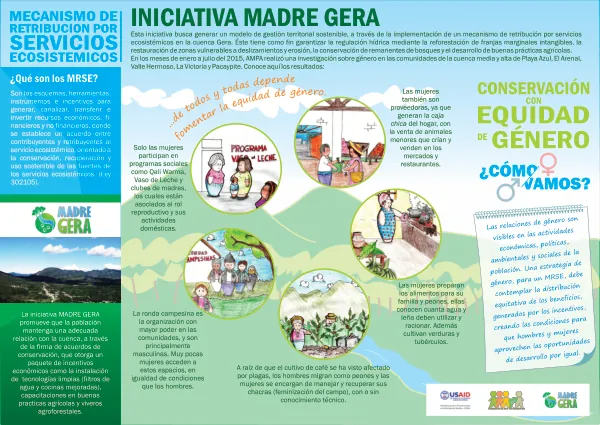
The Iniciativa Madre Gera is a program focused on promoting sustainable agriculture practices in rural communities.
2 pages
Sign in to readA free account is required to download.
Abstract
The initiative began in 2018 with the goal of improving food security and reducing poverty among small-scale farmers. The program's geographic focus is on rural areas of Latin America, with a specific emphasis on the countries of Brazil, Peru, and Ecuador. The program's methodology involves the implementation of two distinct training programs: Rutina Masculina and Rutina Femenina. Rutina Masculina is designed to provide men with the knowledge and skills necessary to adopt sustainable agriculture practices, while Rutina Femenina is tailored to meet the specific needs and challenges faced by women farmers. The training programs cover a range of topics, including crop rotation, composting, and irrigation techniques. Implementation of the program has been underway since 2018, with a focus on scaling up the initiative to reach a larger number of farmers. The program's impact has been evaluated through regular monitoring and assessment, with a focus on measuring changes in household income, food security, and adoption of sustainable agriculture practices. Preliminary results indicate that the program has been successful in improving the livelihoods of participating farmers, with significant gains in household income and food security. The program's success can be attributed to its focus on addressing the specific needs and challenges faced by small-scale farmers, particularly women. The program's emphasis on providing training and support to women farmers has been particularly effective in promoting the adoption of sustainable agriculture practices and improving food security. The program's impact is expected to continue to grow as it is scaled up to reach more farmers and communities. The program's long-term goal is to create a network of sustainable agriculture practitioners who can share knowledge and best practices with other farmers and communities. The program's success will be measured through ongoing evaluation and assessment, with a focus on monitoring changes in household income, food security, and adoption of sustainable agriculture practices.