USAID DEC
USAID Medicines, Technologies, and Pharmaceutical Services (MTaPS) Program: Improved Access. Improved Services. Better Health Outcomes.
Sign inDEPARTMENT OF HEALTH
USAID Medicines, Technologies, and Pharmaceutical Services (MTaPS) Program: Improved Access. Improved Services. Better Health Outcomes.
The USAID Medicines, Technologies, and Pharmaceutical Services (MTaPS) program aims to improve access to safe, effective, and quality-assured medicines and health technologies in the Philippines.
2023 · 7 pages
Sign in to readA free account is required to download.
Abstract
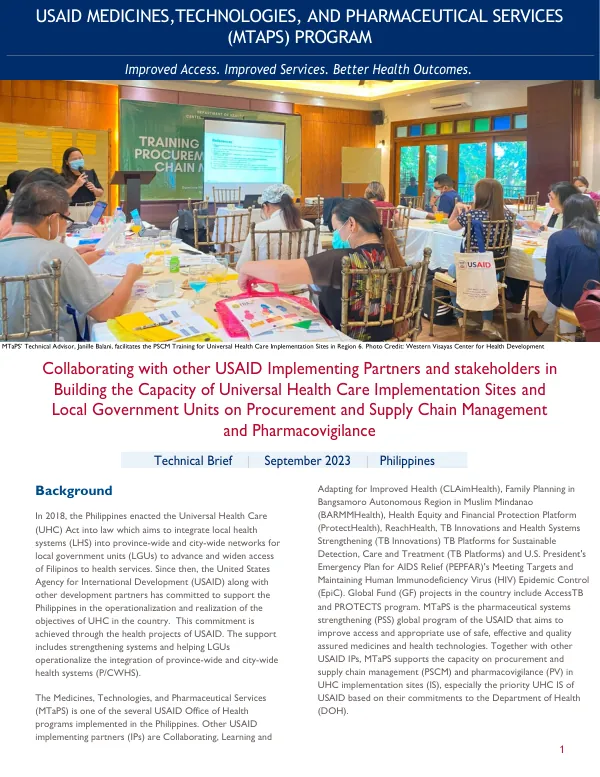
The program is part of the USAID Office of Health's efforts to support the country's Universal Health Care (UHC) implementation. MTaPS collaborates with other USAID implementing partners, the Department of Health (DOH), and local government units to build the capacity of UHC implementation sites on procurement and supply chain management (PSCM) and pharmacovigilance (PV). The program's strategic approach is guided by the LHS Maturity Level (ML) framework, which assesses the integration of local health systems (LHS) into province-wide and city-wide networks. The framework defines performance levels and corresponding key result areas (KRAs) for each health system building block, including Information Management System and Medicines Products, Vaccines, and Technology. MTaPS works closely with the DOH, Centers for Health Development (CHDs), and USAID IPs to build the capacity of UHC IS on PSCM and PV, and to pilot test the use of a digital tool to support the integration of primary care provider networks. MTaPS has developed several courses relevant to PSCM and PV for public health in partnership with the DOH and Food and Drug Administration (FDA). These courses were delivered online through webinars, and as of June 2023, 19,031 professionals have been trained on the MTaPS-developed courses. The courses on health care waste management, infection prevention and control, and supply chain for COVID-19 developed by MTaPS are now readily accessible in the DOH Academy and are accredited with Continuous Professional Development credits granted by the Professional Regulatory Commission (PRC). The program has also implemented an electronic logistics management information system (eLMIS) to support the integration of the country's public health PSCM system. MTaPS has supported the DOH to acquire, configure, and implement an off-the-shelf eLMIS solution, which has been selected as the Entuition Vesta of Bileeta Pvt. Ltd. The program has trained USAID IPs and other development partners on the eLMIS functions and capabilities, and regularly participates in UHC meetings to ensure IPs are informed of the status of the eLMIS implementation. MTaPS has also worked with the DOH, CHDs, and USAID EpiC to standardize the logistics management of HIV commodities, considering the processes and standard forms defined in the DOH warehouse operation manual (WOM). The program has delivered PSCM and PV trainings to 211 service delivery health workers from 109 facilities in the priority USAID PEPFAR regions, which are regions III, National Capital Region (NCR), and IV-A. The support by MTaPS on PV capacity building has been recognized by the FDA in helping address PV underreporting in the country. The implementation of the eLMIS has seen the DOH shift from its initial plan of only acquiring a warehouse management system (WMS) for DOH and CHD warehouses to acquiring an off-the-shelf eLMIS solution. This decision has further solidified the integration of the country's public health PSCM system. MTaPS has shared a live document with all IPs, which is regularly updated with the eLMIS implementation status from the DOH, CHDs, and LGU levels. The program has also had several one-on-one meetings with service delivery IPs, TB Platforms, TB IHSS, and ReachHealth to specifically identify activities that can support the implementation of eLMIS in the priority UHC IS of USAID and IPs.
Related documents