NATIONAL MALARIA CONTROL PROGRAM
Malaria Continuous LLIN Distribution - Lessons in Brief No. 5- Tanzania
The Tanzanian National Voucher Scheme (TNVS) was established in 2004 to promote the use of insecticide-treated nets (ITNs) and make them affordable, accessible, and acceptable to the population at high risk from malaria, namely pregnant women and children under five.
2012 · 4 pages
Sign in to readA free account is required to download.
Abstract
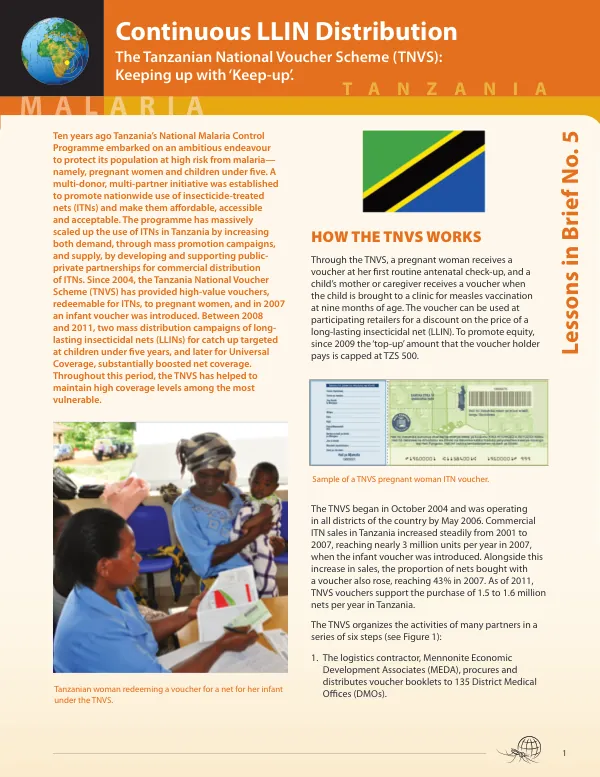
The programme has massively scaled up the use of ITNs in Tanzania by increasing both demand, through mass promotion campaigns, and supply, by developing and supporting public-private partnerships for commercial distribution of ITNs. The TNVS works by providing high-value vouchers, redeemable for ITNs, to pregnant women and children's mothers or caregivers. The vouchers can be used at participating retailers for a discount on the price of a long-lasting insecticidal net (LLIN). To promote equity, the 'top-up' amount that the voucher holder pays is capped at TZS 500. The TNVS began in October 2004 and was operating in all districts of the country by May 2006. Commercial ITN sales in Tanzania increased steadily from 2001 to 2007, reaching nearly 3 million units per year in 2007. The TNVS organizes the activities of many partners in a series of six steps. The logistics contractor, Mennonite Economic Development Associates (MEDA), procures and distributes voucher booklets to 135 District Medical Offices (DMOs). Reproductive and Child Health (RCH) clinic staff receive new voucher booklets from DMOs in exchange for stubs of used booklets. Beneficiaries receive vouchers from RCH clinics during health visits and exchange them for LLINs (plus top-up) at participating local retailers. Retailers keep the TZS 500 top-up and redeem vouchers for more nets from the LLIN supplier. The LLIN supplier returns exchanged vouchers to MEDA and is paid the value of nets by the Voucher Scheme system. The TNVS has made significant contributions to increasing coverage among the most vulnerable populations. The proportion of households owning at least one ITN rose from 23% to 39% from 2004 to 2007. Use among children under five years (U5s) in mainland Tanzania increased from 16% in 2004 to 26.2% in 2007. Between 2009 and 2011, TNVS made possible the distribution of 5.4 million LLINs. As of June 2011, the programme engaged 5,426 retailers and 4,428 Reproductive and Child Health (RCH) clinics nationwide. The TNVS has several key advantages, including avoiding complex logistical problems of distributing bulky and valuable ITNs through an already over-burdened public health system. Using vouchers creates a predictable demand for ITNs in even the most remote corners of the country and attracts retailers to stock LLINs. The availability of vouchers makes attending antenatal (ANC) or immunisation (EPI) services more attractive, leading to increased attendance and earlier attendance in pregnancy. The system addresses problems of equity raised by a purely commercial distribution network that would charge prices too high for many potential customers. The fixed top-up, which caps the amount that the voucher holder pays, assures a high level of equity. The TNVS has been successful due to several factors, including the development of an efficient and effective national supply chain of LLINs, the promotion of the LLIN market by generating large demand for products, broad support from all national and international stakeholders, an integrated systems approach, and almost 10 years of experience and expertise accumulated. The programme has also maintained a high level of equity by capping the top-up rate and promoting cost equity to voucher holders. The TNVS operates alongside behaviour change campaigns and has been effective in maintaining high levels of LLIN ownership and use. However, the TNVS has fallen somewhat short of its full potential, and several factors need to be addressed to achieve maximum potential, including the availability of vouchers at the DMO and clinic, the willingness and ability of the intended beneficiaries to attend RCH clinics, the willingness of clinic staff to issue vouchers, the willingness of beneficiaries to accept and redeem vouchers, the willingness and ability of beneficiaries to pay the top-up price, access to a participating retail outlet, and the availability of the LLIN in the retail outlet. To maintain high levels of LLIN ownership and use, ways to distribute significantly more LLINs will be needed. These could include school-based distribution of vouchers and community-based distribution of nets. School-based distribution of vouchers could consist of giving vouchers every year to students in 'odd' grades and redeeming them for LLINs at the same network of retail shops as for TNVS. This would allow nets to be shared with family members who are not of school age and would allow for replacement of the oldest net in the household as the student moves through school. Community distribution of nets or vouchers could be done semi-annually, quarterly, or as needed to enable households to obtain nets to satisfy their ongoing needs.