JHPIEGO
Review of National-Level Malaria in Pregnancy Documents in Five PMI Focus Countries
The President's Malaria Initiative (PMI) supports the World Health Organization's (WHO) recommended three-pronged approach for managing malaria in pregnancy (MIP).
2012 · 42 pages
Sign in to readA free account is required to download.
Abstract
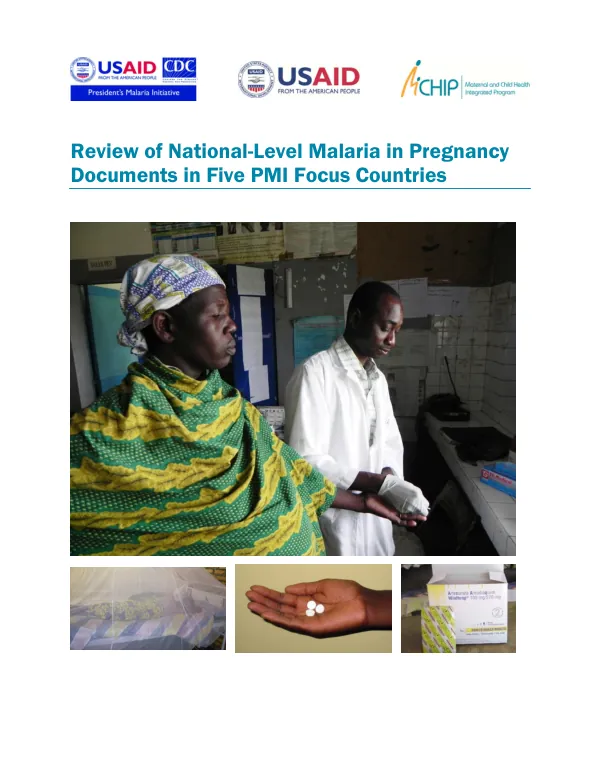
This approach includes promotion and distribution of long-lasting insecticidal nets (LLINs) to pregnant women, intermittent preventive treatment in pregnancy (IPTp) with sulfadoxine-pyrimethamine (SP), prompt diagnosis and effective treatment of confirmed malaria cases, and prevention and treatment of maternal anemia. Among the 19 PMI focus countries in sub-Saharan Africa, there has been steady progress in achieving the PMI target of 85% coverage of LLIN use among pregnant women. However, limited progress has been made in achieving the PMI target of 85% coverage of IPTp2—two doses of SP. While some countries, including Zambia, Malawi, and Senegal, have achieved higher coverage of IPTp uptake and, to an extent, insecticide-treated net (ITN) coverage among pregnant women, use of these interventions across sub-Saharan Africa is generally abysmally low. Factors contributing to low coverage include late antenatal care (ANC) attendance, insufficient coordination of commodities leading to stock-outs of SP in facilities, inadequate and high turnover in staffing at facilities, poor dissemination of guidelines among providers, and/or conflicting or unclear guidelines about IPTp, and insufficient resources to support MIP programs. In October 2012, the WHO Malaria Policy Advisory Committee reviewed the most recent evidence on the efficacy and effectiveness of IPTp-SP in light of growing SP resistance in children and potential SP resistance in pregnant women receiving IPTp-SP. The new WHO recommendation states that IPTp-SP should be given as early as possible in the second trimester and at each scheduled ANC visit thereafter, at least one month apart. PMI is interested in assessing the current status of national-level MIP documents in light of the new WHO IPTp policy recommendations and with the understanding that countries will need to revise these documents to disseminate the new policy. It is essential that reproductive health (RH) and malaria control programs harmonize country policies, guidelines, and training materials based on the latest WHO guidance. The review of national-level MIP documents in five PMI focus countries, including Kenya, Mali, Mozambique, Tanzania, and Uganda, is a critical step in understanding the current status of MIP programs and identifying areas for improvement. The review aims to assess the alignment of national-level MIP documents with the new WHO IPTp policy recommendations and to provide recommendations for revising these documents to ensure that they are consistent with the latest WHO guidance. The review of national-level MIP documents in these five countries reveals that while some countries have made progress in implementing the WHO-recommended MIP strategy, there are significant gaps in the implementation of IPTp-SP. For example, in Kenya, the national MIP strategy recommends the use of IPTp-SP, but the implementation of this strategy is limited by inadequate coordination of commodities and poor dissemination of guidelines among providers. In Mali, the national MIP strategy recommends the use of IPTp-SP, but the implementation of this strategy is limited by inadequate resources to support MIP programs. The review of national-level MIP documents in these five countries highlights the need for a strong partnership between national RH programs and malaria control programs to manage implementation and national MIP programs. It is essential that these programs harmonize country policies, guidelines, and training materials based on the latest WHO guidance to ensure that MIP programs are effective in reducing the consequences of MIP.