DEPARTMENT FOR INTERNATIONAL DEVELOPMENT
Malaria Continuous LLIN Distribution - Lessons in Brief No. 3- Malawi
Malawi's National Malaria Control Programme (NMCP) has achieved significant success in the continuous distribution of long-lasting insecticidal nets (LLINs) nationwide.
2012 · 4 pages
Sign in to readA free account is required to download.
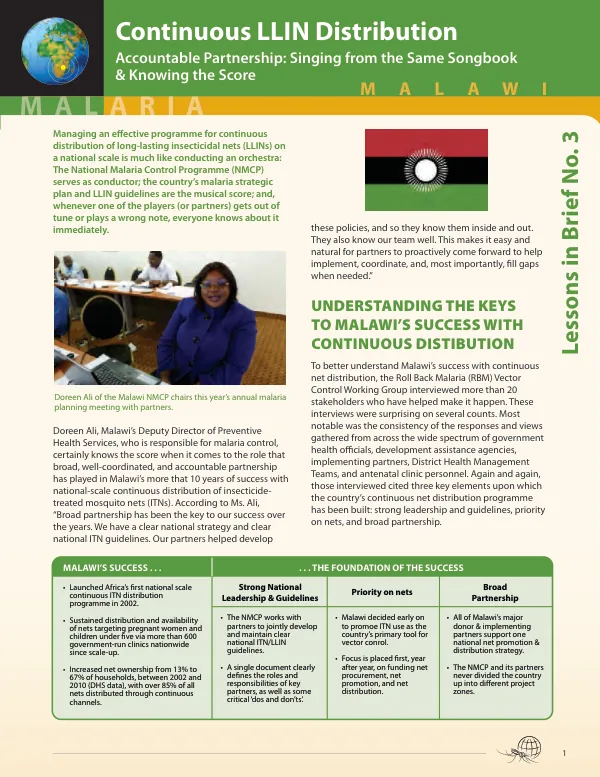
Abstract
The programme's success is attributed to three key elements: strong national leadership and clear national ITN/LLIN guidelines, priority on nets for vector control, and broad partnership. Strong national leadership and clear national ITN/LLIN guidelines have been the most vital elements of Malawi's success. The NMCP has benefited from the vision and expertise of partner organizations such as WHO, UNICEF, USAID, DfID, CDC, JICA, GTZ, and PSI. The NMCP's decision to develop with its partners a clear set of national ITN guidelines has enabled transparency and accountability in the programme. The guidelines, first published in June 2002, define the roles and responsibilities of key partners, as well as critical 'dos and don'ts'. The guidelines have been updated to reflect the country's shift from highly subsidized distribution to free distribution in late 2006, and updated again after shifting to LLINs in 2008-2009. Malawi's commitment to ITNs started in the early 1990s, when much of the world began recognizing that insecticide-treated nets were significantly more effective at preventing malaria than conventional nets. The sustained commitment to nets as the primary vector control strategy has been vital to focusing the resources of the nation and of the broad range of bi-lateral and multi-lateral partners supporting malaria control in Malawi. The NMCP's success in securing the funds needed to grow and maintain its continuous distribution programme over time is evident in Figure 1. Broad partnership has been cited unanimously by stakeholders as a crucial element of Malawi's long-term success with continuous net distribution. The NMCP has aligned the resources and energies of all its partners to support one national net distribution and promotion strategy. Unlike many other countries, Malawi has never been 'divided up' into different implementation areas supported by different donors and/or implementing partners. The well-coordinated partnership, combined with the existence of clear national policies, makes it easier for partners to fill resource gaps as they arise. Malawi's experience demonstrates that it takes more than simply assembling a broad and diverse set of qualified and talented partners to make a national net distribution programme function effectively over time. The programme must be built upon a solid foundation that empowers partners to take action and hold one another mutually accountable for their joint success or failure. The three fundamental building blocks of Malawi's success are strong national leadership and clear national ITN/LLIN guidelines, priority on nets for vector control, and broad partnership. The NMCP's 'green nets' protect the country's most vulnerable populations. The programme's success has been sustained over time, with a 27% increase in household income among programme participants compared to the control group. Malawi's experience serves as a model for other countries seeking to establish effective national net distribution programmes.