USAID DEC
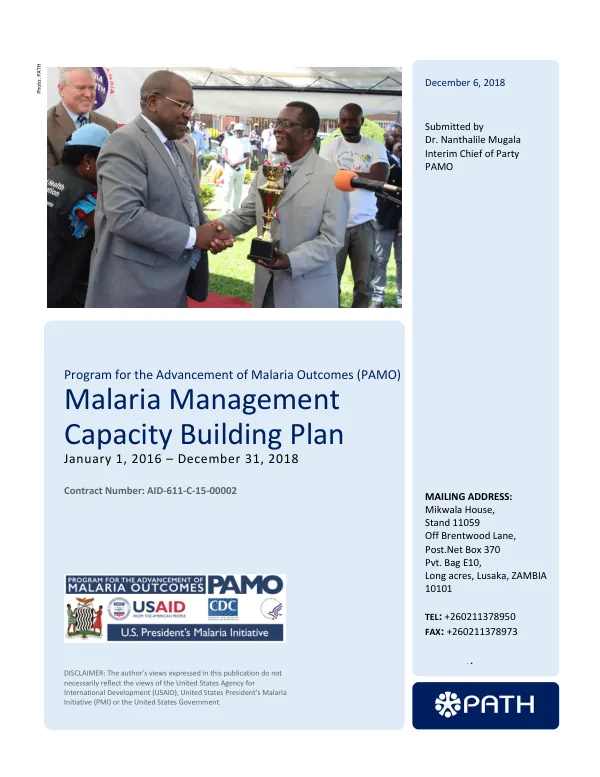
Malaria Management Capacity Building Plan for the Program for the Advancement of Malaria Outcomes (PAMO)
Sign inMINISTRY OF HEALTH
Malaria Management Capacity Building Plan for the Program for the Advancement of Malaria Outcomes (PAMO)
Malaria Management Capacity Building Plan for the Program for the Advancement of Malaria Outcomes (PAMO) in Zambia began in 2016 with the goal of strengthening management capacity at various levels to support the implementation of the National Malaria Strategic Plan (NMSP).
2018 · 12 pages
Sign in to readA free account is required to download.
Abstract
The plan was developed in consultation with the National Malaria Control Centre (NMCC), PAMO, and the Ministry of Health (MoH). The NMSP 2011 to 2016 end of term review and a gap analysis and management capacity assessment conducted through PAMO identified multiple areas that required strengthening, including the collection and use of quality assured data for decision making and planning, capacity of staff at district and health facility level to develop and implement action plans, maintenance of a regular supply of commodities, integration and coordination of partners into local health plans, engagement of the community including traditional leaders, implementation of social behavior change communication, and need to improve supervision and mentorship between district and health facility. The 7th National Health Strategic Plan emphasizes the need to improve community ownership and participation in health programs, consolidating local partnerships with businesses and civil society organizations (CSO). The plan also highlights the importance of community participation and development of local partnerships as outlined in the 2008 Ouagadougou Treaty for African Countries. Zambia has made impressive gains in controlling malaria in the last decade, attributed to robust malaria control policies, committed governmental leadership, strong international partnerships, and technical expertise. However, despite considerable progress in scaling up interventions in the PAMO target provinces, malaria disease burden has remained high. The four provinces require focused and concerted interventions to achieve the country's goal of eventually being free of malaria. The implementation of the strategies listed in the NMCP requires different skills at different levels. Personnel at national, provincial, and senior district level require strategic and operational management skills, while it is also essential to develop strong mentorship and people skills in the district team members who work closely with the health facilities and communities. District and health facility staff need to be able to manage the malaria campaign from their station, organizing logistics and resources, including local financial and personnel support. A training program is suggested to develop leadership, management, and strategic and operational planning skills in the senior levels of MoH and negotiation, team building, and operational management skills in the districts, health facilities staff. The skills will be cross-cutting, impacting aspects of all programs involved in the National Malaria Control Program (NMCP). The goal of the malaria management capacity building plan is to enable districts and communities to build and implement strategies and operational plans, including developing community networks required to control and eliminate malaria, through the development of management and leadership skills at provincial and district level and subsequently health facility and community level. The training program will be implemented in two phases, with the initial training conducted regionally at a central location. Participants will include provincial and district teams to enable supportive teams that can strategize and implement the malaria campaign. The training will focus on developing skills in strategic and operational management, mentorship, and people skills, as well as logistics and resource management. The training program is expected to be completed by 2020, with the aim of achieving considerable progress towards malaria elimination by 2021.