USAID
Malawi Fisheries Profile
Fisheries play a vital role in Malawi's food security and economy.
2015 · 2 pages
Sign in to readA free account is required to download.
Abstract
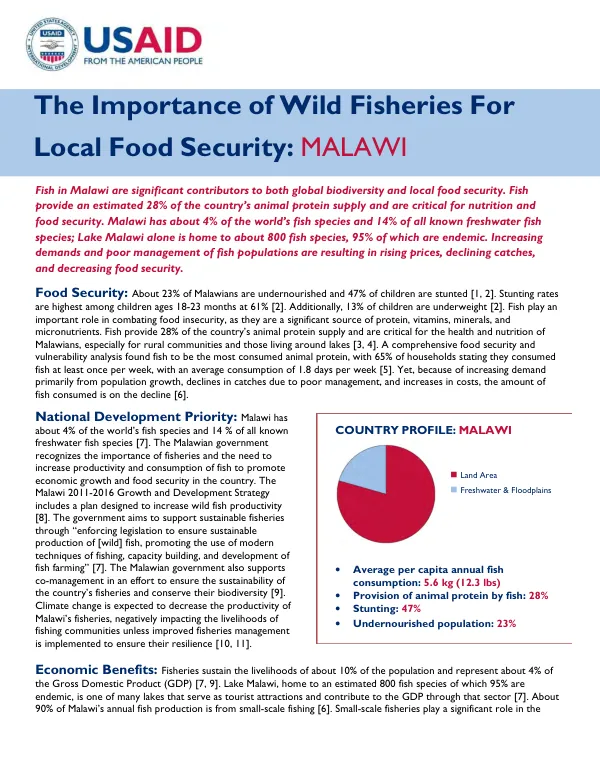
The country's fish species contribute significantly to global biodiversity, with 4% of the world's fish species and 14% of all known freshwater fish species found in Malawi. Lake Malawi alone is home to approximately 800 fish species, 95% of which are endemic. Fish provide an estimated 28% of the country's animal protein supply and are critical for nutrition and food security. Malawi has a significant undernourished population, with 23% of the population undernourished and 47% of children stunted. Stunting rates are highest among children aged 18-23 months at 61%. Fish consumption is a significant source of protein, vitamins, minerals, and micronutrients, with 65% of households consuming fish at least once per week. However, due to increasing demand, declines in catches, and increases in costs, the amount of fish consumed is on the decline. The Malawian government recognizes the importance of fisheries and has included a plan to increase wild fish productivity in the Malawi 2011-2016 Growth and Development Strategy. The government aims to support sustainable fisheries through enforcing legislation, promoting modern fishing techniques, capacity building, and development of fish farming. Climate change is expected to decrease the productivity of Malawi's fisheries, negatively impacting the livelihoods of fishing communities unless improved fisheries management is implemented. Fisheries sustain the livelihoods of about 10% of the population and represent about 4% of the Gross Domestic Product (GDP). Lake Malawi is a significant contributor to the GDP through tourism and fish production. Small-scale fisheries play a crucial role in the livelihoods of rural populations, employing about 60,000 fishers and indirectly employing over half a million Malawians through processing, fish marketing, and boat building and repair. Many of these employees are rural women involved in fish processing and marketing. The demand for fish is increasing, with individual fish consumption estimated at 5.6 kg/year, a significant drop from 14 kg/year in the 1970s. Yields from the lakes are declining, with Lake Chilwa's total catch dropping by more than a third since the 1990s. Rural fishing communities are facing difficulties in the wake of declining catches and are turning to reducing mesh sizes and using environmentally destructive fishing gear to increase their catch. The southeast arm of Lake Malawi has the most nutrient-rich water, supports a richer fishery, and has the highest productivity per unit area, contributing over 25% of the total catch in Malawi.