CARE MALAWI
Mali Country Plan: Water for the World Country Plan
Mali's water, sanitation, and hygiene (WASH) sector faces significant challenges in promoting sustainable and equitable access to water.
2020 · 7 pages
Sign in to readA free account is required to download.
Abstract
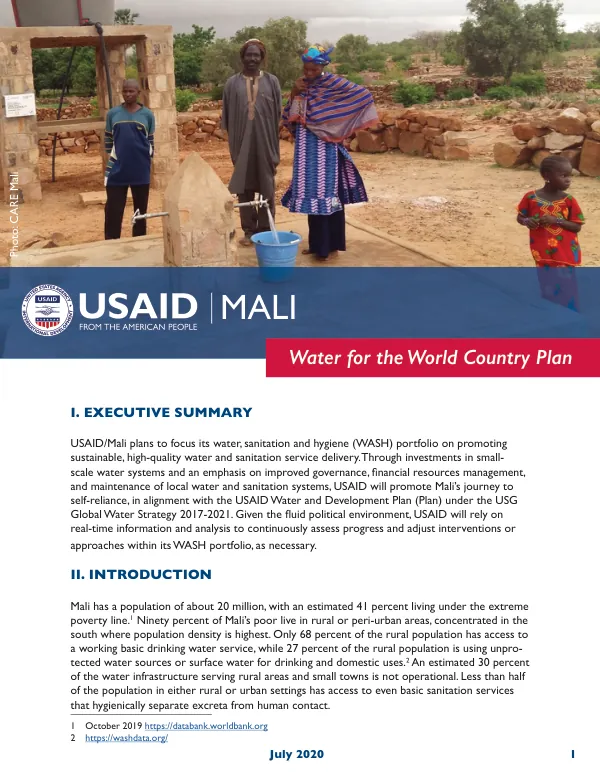
The country's population of approximately 20 million, with 41% living under the extreme poverty line, is concentrated in rural or peri-urban areas. Only 68% of the rural population has access to a working basic drinking water service, while 27% relies on unprotected water sources or surface water for drinking and domestic uses. The Government of Mali's (GoM) 2019-2023 national strategy for economic growth and sustainable development includes WASH as an objective, aiming to attain 100% access to at least basic services by 2030, in line with the Sustainable Development Goals (SDGs). However, structural weaknesses in local government procedures and personnel systems hinder implementation, including the lack of funding transfers from national and regional tax revenues to the communes. Mali's decentralization process transferred asset ownership and contracting authority for WASH services to the communes, but the process for devolved services and funding at the commune level starts with a five-year planning process (Programmes de Développement Économique Social et Culturel, or PDSEC) that captures development objectives, medium-term investment needs, challenges, and opportunities. Funding includes all sources: national government, donors, private sector, and locally-generated revenues. However, GoM funding for communal PDSEC plans is up to the presidentially-appointed governor of each region, and therefore, decentralized funding becomes politicized and cannot be relied upon for basic and necessary infrastructure services like WASH. The WASH sector in Mali is actively undergoing reforms, with both the Water Law and Water Policy being technically validated and under review by the Conseil de Ministres. The National Drinking Water Program and National Sanitation Programs are in the process of being costed and will be submitted for review and approval by the Conseil once the Water Policy has been signed. The GoM supports communes to include WASH in their PDSEC requests, although the commitment to provide funding has not followed. Mali's population growth rate of almost three percent per year poses a significant challenge for the WASH sector, given that funding deficits already exist. The country's economy is projected to grow at 5.1 percent, but this rate was made prior to the coronavirus pandemic, and the GoM now expects a growth rate in 2020 of 0.9 percent, which poses a real challenge for GoM WASH contributions in the near future. Despite this, the private sector has called for reforms to the business and investment climate, particularly strengthening legal certainty for small businesses and more access to microfinance loans, which would be a boost to Malian businesses in all sectors, including WASH. Inadequate drinking water, sanitation, and hygiene pose critical health and nutrition risks to all children, but there are additional implications for the health, psychosocial well-being, and mobility of women and girls who are primarily responsible for water collection in Mali. Use of sanitation facilities that are shared with other households and open defecation practices increase the risk of sexual assault for women and girls, in addition to impeding their ability to safely manage their monthly menstrual cycles in privacy and with dignity. Mali's WASH program will promote women and girls as sector professionals, either through work in WASH service provision or indirectly through a range of economic opportunities that depend on water, and support increased female representation in decision-making at the institutional and community level.