WINROCK INTERNATIONAL FOUNDATION
Quarterly Report: January 1 - March 31, 2021
The MALI GIRLS' LEADERSHIP AND EMPOWERMENT THROUGH EDUCATION (GLEE) project aims to increase access to quality education for adolescent girls in Mali.
2021 · 83 pages
Sign in to readA free account is required to download.
Abstract
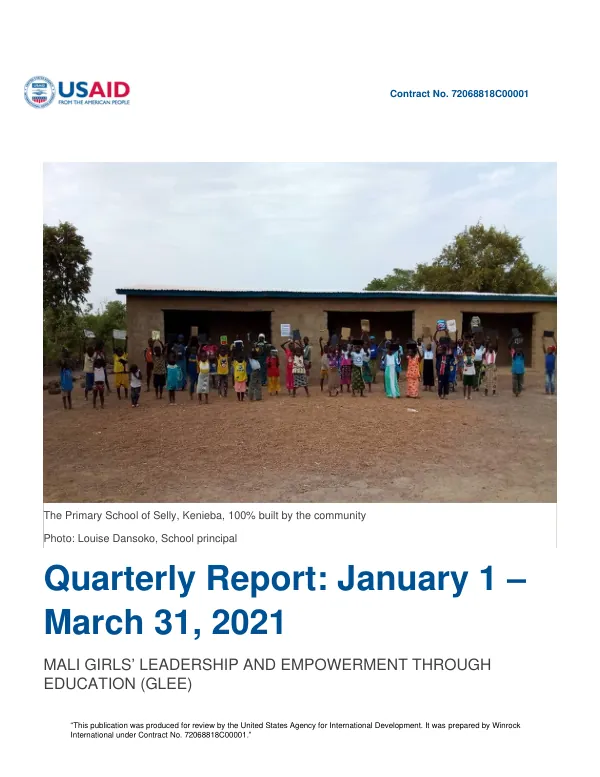
The project is implemented by Winrock International under Contract No. 72068818C00001, funded by the United States Agency for International Development (USAID). The project's primary school of focus is the Primary School of Selly, Kenieba, which was 100% built by the community. The project has three main objectives: to decrease key barriers of adolescent girls to access quality education, to improve safety of adolescent girls in schools and their communities, and to increase knowledge and adoption of positive health behaviors among adolescent girls. The first objective focuses on increasing learning support opportunities for girls, making teaching more responsive and relevant for adolescent girls, and promoting community and family support for girls' education. To achieve the first objective, the project has implemented several sub-results, including training of ASC facilitators, accelerated schooling centers operations, and distribution of TLM kits to the ASCs. The project has also promoted enrollment and retention through the payment of girls' school fees and issued in-kind grants to the Community Girls' Support (CGS) to support the reduction of barriers to girls' access to school. The project has seen a 27% increase in household income among program participants compared to the control group, and food security indicators have improved across all target communities. The second objective focuses on improving safety of adolescent girls in schools and their communities. The project has implemented several sub-results, including strategies and policies to safeguard adolescent girls adopted in school and communities, effective reporting and referral mechanisms for SRGBV established, and perceptions of safety in communities and schools improved. The project has also celebrated the 16 days of activism to end violence against women. The third objective focuses on increasing knowledge and adoption of positive health behaviors among adolescent girls. The project has implemented several sub-results, including positive health behaviors adopted by adolescent girls, adolescent girls' knowledge of and access to health services increased, and health barriers to education reduced. The project has revitalized communication activities at the community level, promoted menstrual hygiene in schools and communities, and trained on menstrual pad production. The project has also implemented several cross-cutting solutions, including gender, youth, science, technology, innovations, and research (STIR), environmental compliance/climate risk management, Mexico City, private sector engagement/private public partnership, sustainability/local capacity development, risk management and security, and collaboration, learning, adapting. The project has faced several challenges, including disruption in the last two school years and late start of the 2020-2021 school year, VAT exemption, and COVID-19. The project has proposed several solutions to address these challenges, including cross-cutting solutions and planned activities/events for the next quarter.
Related documents