GOVERNMENT OF MALAWI
Mali Livestock for Growth FY15 Quarter 1 Progress Report
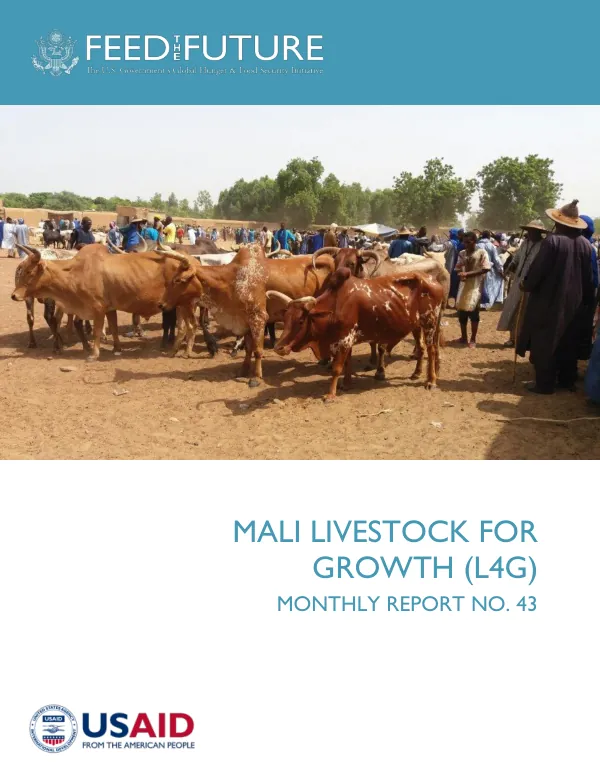
The USAID Mali Livestock for Growth (L4G) program aims to improve the quality of livestock, expand market access and incentives, and include poorer households in livestock value chain development.
2015 · 26 pages
Sign in to readA free account is required to download.
Abstract
The program targets herders and small producers who do not have reliable access to inputs or financial services, particularly female producers, who are largely isolated from markets and training programs due to cultural norms. L4G also considers youth to be a vulnerable population due to their lack of access to education, land, financial services, extension services, and high rates of unemployment. The program conducts its activities in line with the Year 1 work plan (FY 2015) approved by USAID/Mali and with funding obligated to date. L4G carries out activities in close collaboration with local partners, including the Mopti provincial government agencies, Cercle governments, Commune mayors, livestock business groups, producer organizations (POs), and women's and youth groups. Significant L4G Year 1 activities include training private sector veterinary service providers to build their businesses and engage producer clients on improved livestock health management. L4G also works with for-profit livestock POs to improve member income and create resource management plans to better manage pastureland and water. Additionally, the program promotes agroforestry systems (including Moringa) and provides technical assistance for water harvesting and water storage to improve availability of livestock fodder into the lean season. This is achieved by prolonging the forage growing season and improving livestock access to water. The program focuses on the livestock production and trading center of Mopti Region, targeting 21 communes in Bankass and Koro Cercles. L4G's activities are designed to address the needs of vulnerable populations, including female producers and youth, who are often isolated from markets and training programs. By improving access to inputs, financial services, and extension services, L4G aims to increase the income and productivity of small-scale livestock producers. The program's intermediate results (IRs) and sub-IRs are listed in Figure 1, which outlines the key objectives and indicators for the program. L4G's activities are closely monitored and evaluated to ensure that they are meeting the program's objectives and making a positive impact on the lives of small-scale livestock producers in Mali. In terms of specific activities, L4G has made significant progress in training private sector veterinary service providers to build their businesses and engage producer clients on improved livestock health management. The program has also worked with for-profit livestock POs to improve member income and create resource management plans to better manage pastureland and water. Additionally, L4G has promoted agroforestry systems (including Moringa) and provided technical assistance for water harvesting and water storage to improve availability of livestock fodder into the lean season. Overall, the USAID Mali Livestock for Growth (L4G) program is making a positive impact on the lives of small-scale livestock producers in Mali by improving access to inputs, financial services, and extension services. The program's activities are designed to address the needs of vulnerable populations, including female producers and youth, and are closely monitored and evaluated to ensure that they are meeting the program's objectives.
Related documents