MICHIGAN STATE UNIVERSITY FOUNDATION
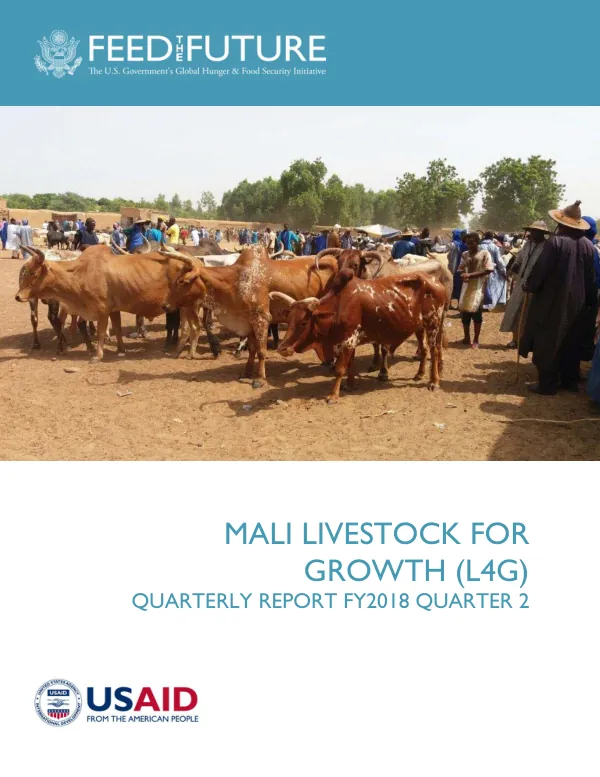
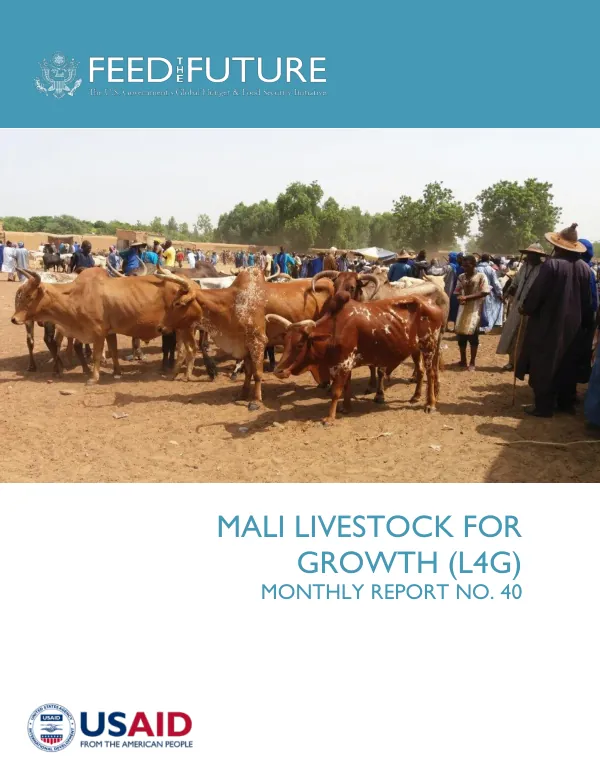
Mali Livestock for Growth (L4G) Monthly Report No. 40, February 2018
The agricultural development initiative in Mali, known as the Mali Livestock for Growth (L4G) program, aims to increase animal production and access to technologies, as well as promote favorable business environments for the livestock sub-sector.
2018 · 32 pages
Sign in to readA free account is required to download.
Abstract
The program is implemented by AECOM International Development and is funded by the United States Agency for International Development (USAID). The L4G program focuses on several key components, including increased animal production and access to technologies, increased livestock trade with reduced barriers, and strengthened capacity of key national livestock stakeholders. The program also aims to promote favorable business environments for the livestock sub-sector. In February 2018, the L4G program achieved several key results, including the vaccination of 45,431 animals against contagious pneumonia, pasteurellosis, and small ruminant pasteurellosis. The three SVPPs (Supportive Veterinary Production Programs) achieved an overall gross margin of 3,499,146 or $6,998 USD. Additionally, 934 KG of seeds, comprising cowpea, groundnut, and sorghum, were reimbursed by the Producer Organizations (POs) in Djenne, and 237 KG of seeds were reimbursed in Bankass. The program also made progress in increasing livestock trade with reduced barriers. During the period under review, 1,709 livestock, comprising 315 cattle heads, 1,099 sheep, and 295 goats, were purchased by 132 POs and 67 individuals for the fattening operations in various regions of Mali. The total value of animals sold during this period was estimated at 93,431,700 CFA or about $186,864 USD. Furthermore, the program made progress in strengthening the capacity of key national livestock stakeholders. A consultation meeting was organized to discuss the status of equipment/materials provided to the Animal Health Extension Agents (AEs) by L4G. The meeting revealed that several materials/equipment were still available for use, including automatic syringes, ordinary syringes, and veterinarian products. The program also faced several challenges, including security concerns. The Government of Mali banned the circulation of motorbikes and pickup vehicles in certain regions, which affected the program's activities. However, the Government later authorized development partners to move around with prior authorization papers from local administrative and military authorities. Overall, the L4G program made significant progress in February 2018, achieving several key results and making progress in its key components. The program continues to face challenges, but it remains committed to its goals of increasing animal production and access to technologies, promoting favorable business environments for the livestock sub-sector, and strengthening the capacity of key national livestock stakeholders.
Related documents