GOVERNMENT OF MALAWI
Mali Livestock for Growth FY15 Quarter I1 Progress Report
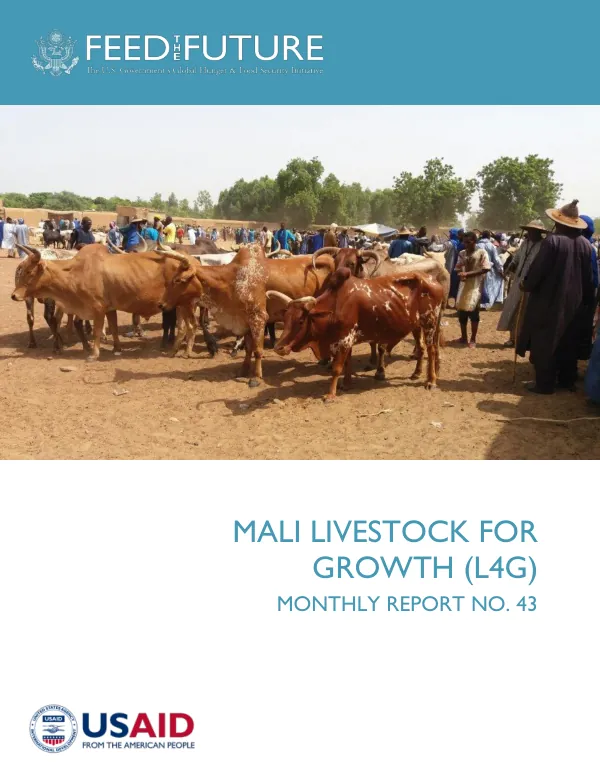
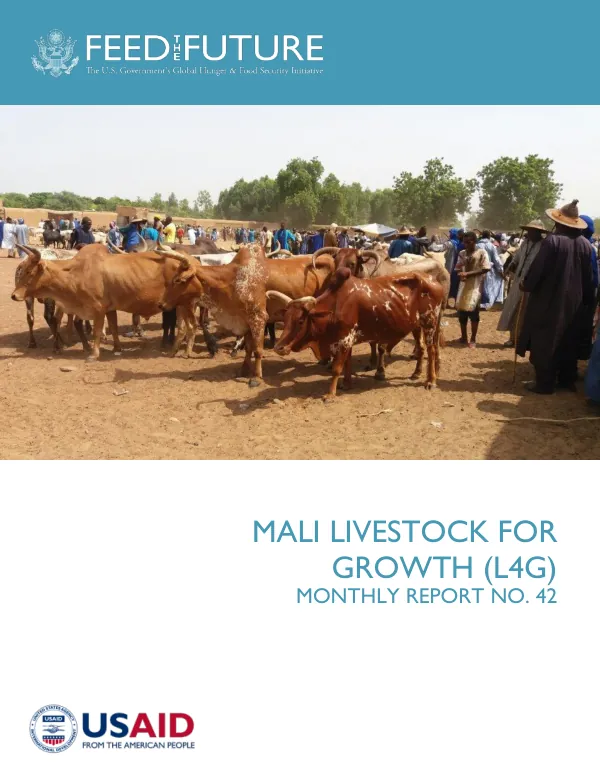
The Mali Livestock for Growth (L4G) program aims to improve the quality of livestock, expand market access and incentives, and include poorer households in livestock value chain development.
2015 · 25 pages
Sign in to readA free account is required to download.
Abstract
The program targets herders and small producers who do not have reliable access to inputs or financial services, particularly female producers, who are largely isolated from markets and training programs due to cultural norms. L4G also considers youth to be a vulnerable population due to their lack of access to education, land, financial services, extension services, and high rates of unemployment. L4G carries out activities in close collaboration with local partners, including the Mopti provincial government agencies, Cercle governments, Commune mayors, livestock business groups, producer organizations (POs), and women's and youth groups. Significant L4G Year 1 activities include training private sector veterinary service providers to build their businesses and engage producer clients on improved livestock health management. Additionally, L4G works with for-profit livestock POs to improve member income and create resource management plans to better manage pastureland and water. The program focuses on the livestock production and trading center of Mopti Region, targeting 21 communes in Bankass and Koro Cercles. L4G conducts its activities in line with the Year 1 work plan (FY 2015) approved by USAID/Mali and with funding that is obligated to date. The program's intermediate results comprise the results framework for L4G, which includes increased livestock productivity, increased domestic and export livestock trade, increased resilience of vulnerable communities and households, strengthened local capacities and systems, and an improved enabling environment for the livestock sector. The L4G team planned and oversaw a successful program launch on January 14, 2015, with nearly 250 people in attendance. The event was marked by traditional Fulani and Dogon dances, and the USAID Mission Director, Gary Juste, noted the importance of the L4G program for economic growth in Mali. The program's launch was covered by Malian state TV and the Malian "Independent" Newspaper published a half-page article about the event on January 19. Component 1: Increased Livestock Productivity focuses on enhancing technology innovation, dissemination, and management, increasing access to quality inputs and services, improving pastureland and water resources management, and improving community literacy, numeracy, and nutrition and hygiene practices. The component aims to increase livestock productivity through the implementation of improved livestock health management practices, improved pastureland and water resources management, and increased access to quality inputs and services. Component 2: Increased Domestic and Export Trade focuses on strengthening market access and linkages, decreasing barriers to trade, and increasing domestic and export livestock trade. The component aims to increase domestic and export livestock trade through the implementation of market access and linkages, decreasing barriers to trade, and increasing the competitiveness of Malian livestock products. Component 3: Strengthened Local Capacities and Systems focuses on strengthening the capacity of local actors, including producer organizations, livestock business groups, and women's and youth groups. The component aims to strengthen local capacities and systems through the implementation of training programs, capacity building activities, and the establishment of resource management plans. Component 4: Improved Enabling Environment for Livestock Sector focuses on increasing the capacity of civil society for policy analysis and advocacy, improving the enabling environment for the livestock sector, and increasing the competitiveness of Malian livestock products. The component aims to improve the enabling environment for the livestock sector through the implementation of policy analysis and advocacy activities, improving the regulatory framework for the livestock sector, and increasing the competitiveness of Malian livestock products. The program's activities are monitored and evaluated through the implementation of a performance monitoring plan (PMP) and a monitoring and evaluation plan (MEP). The PMP and MEP are used to track progress towards the program's intermediate results and to identify areas for improvement. The program's financial report is also included in the annexes of this report.
Related documents