USAID
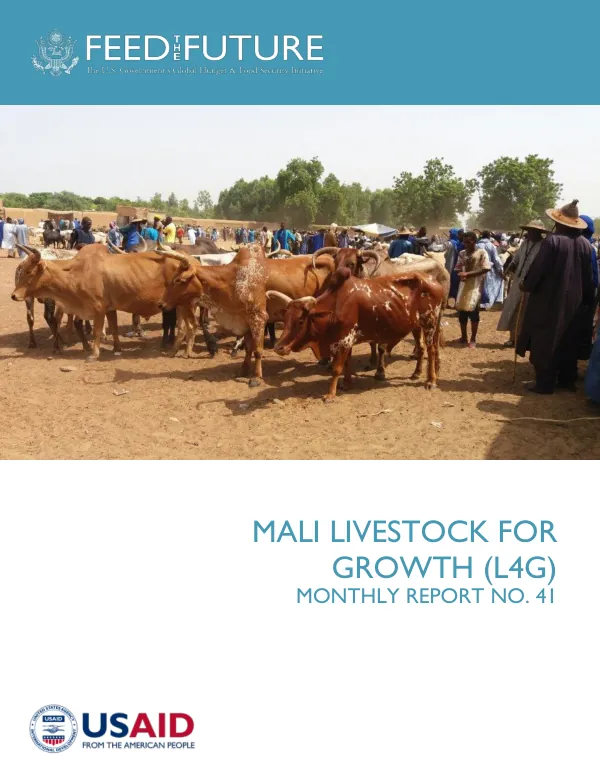
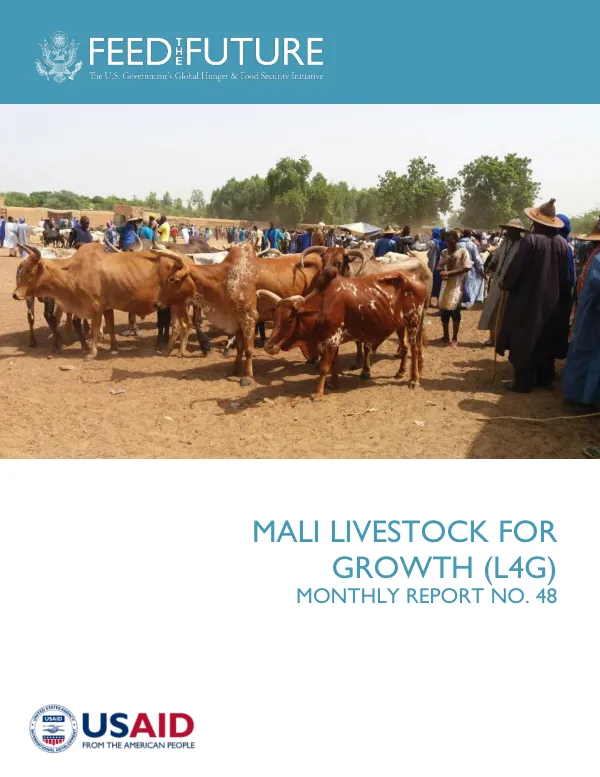
Mali Livestock for Growth (L4G) Monthly Report No. 48
The Mali Livestock for Growth (L4G) program is a USAID-funded initiative aimed at improving the productivity and competitiveness of the livestock sector in Mali.
2018 · 8 pages
Sign in to readA free account is required to download.
Abstract
The program focuses on increasing livestock productivity, domestic and export trade, and improving access to financial and business development services. Component I of the program, Increased Livestock Productivity, is led by the private veterinary services (SVPPs) in Bankass and Koro Cercles. The SVPPs continue to monitor and support the vaccination of animals against Pasteurellosis, with one Bankass vet vaccinating 1,957 animals during the reporting period. The vaccination operations are expected to continue, with the SVPPs sensitizing producers to vaccinate their animals and raising awareness of animal fatteners to adopt more appropriate practices in animal health. The program also focuses on developing and disseminating messages about good livestock management practices and issues. Farmer Field Schools (FFS) for animal fattening and production were established, with 17 POs in Bankass trained on simplified business management tools. The FFS participants completed income statements for sheep fattening and cattle fattening, with the program aiming to reach 80 demonstration sites by the end of the fiscal year. Component II of the program, Increased Domestic and Export Trade, focuses on strengthening market linkages and access. The program has been working with the Network of Koro Fatteners to revise their forward contracts with LAHAM. The negotiations have resulted in a trial delivery of 41 cattle weighing 13,247.50 KG, purchased by LAHAM at an overall profit of 13,909,875 CFA or 26,496 USD for the POs. The program has also been sensitizing producers and fatteners' groups on adapting Livestock as a Business and purchasing animals for fattening. During the reporting period, 50 POs and 5 individual fatteners purchased 1,393 animals, comprising 172 cattle, 925 sheep, and 296 goats. The total value of the animals sold to domestic markets from all Cercles was estimated at 112,135,000 CFA/224,270 USD, with majority of clients purchasing sheep (65%), then cattle (29%), and goats respectively (6%). The program has also been working on improving access to financial services, with Micro-Finance Institutions gradually increasing their financing to L4G clients. During the period, Bankass PO Anagara secured a 1,500,000 CFA/3,000 USD loan with MFI Nayral NEF, which will be shared by 31 women-producers engaged in livestock fattening activities. The program has also been working on reducing barriers to domestic and export trade, with the goal of improving access to financial and business development services. The program has been collaborating with other stakeholders, including the Ministry of Agriculture, to achieve this goal. Overall, the Mali Livestock for Growth (L4G) program is making significant progress in improving the productivity and competitiveness of the livestock sector in Mali. The program's focus on increasing livestock productivity, domestic and export trade, and improving access to financial and business development services is expected to have a positive impact on the livelihoods of rural communities in Mali.
Related documents