USAID
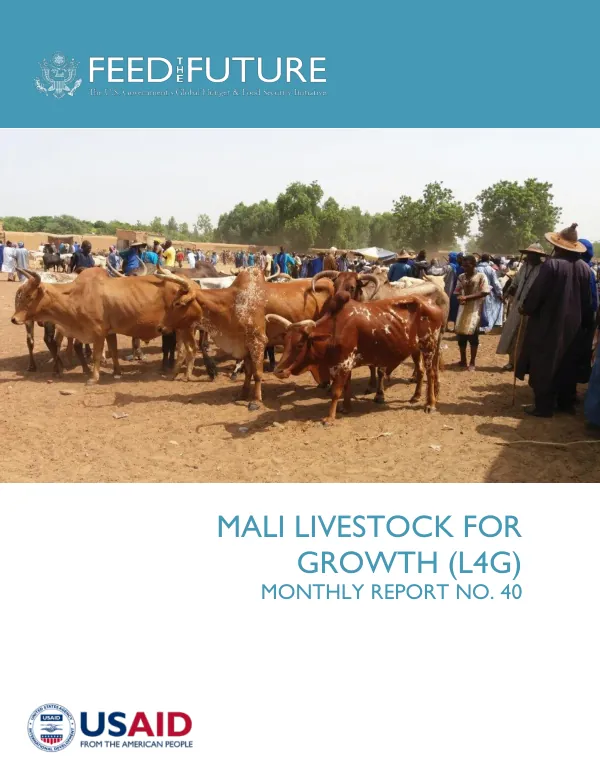
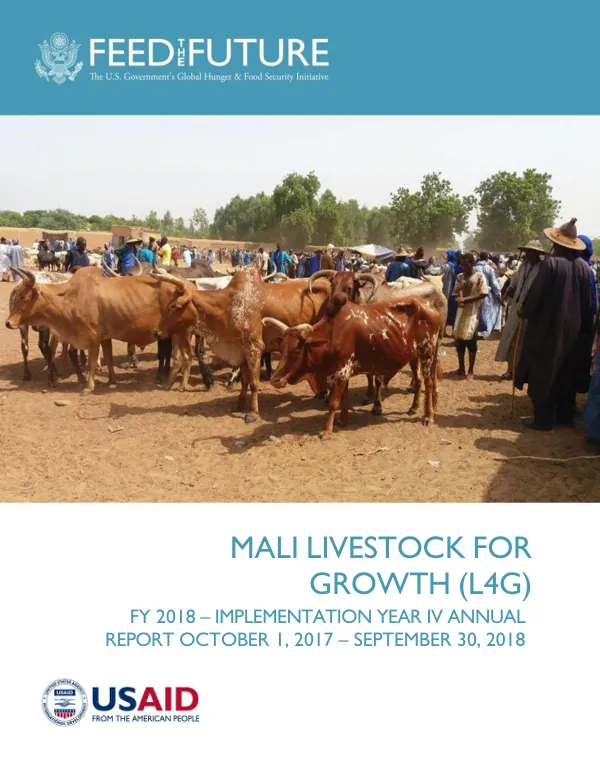
Mali Livestock for Growth (L4G) FY 2018 – Implementation Year IV Annual Report
The Mali Livestock for Growth (L4G) program is a USAID-funded initiative aimed at improving the livestock sector in Mali.
2018 · 122 pages
Sign in to readA free account is required to download.
Abstract
The program's primary objective is to increase the productivity and profitability of the livestock industry, with a focus on enhancing the quality of life for rural communities. Component I of the program, Increase Livestock Productivity, is divided into four sub-components. Sub-IR 1: Enhanced Technology Innovation, Dissemination, and Management focuses on improving the availability and accessibility of quality inputs and services for livestock producers. This includes the distribution of improved breeds, vaccines, and veterinary care. In 2018, over 1.3 million animals were vaccinated in the Koro and Bankass cercles, resulting in a significant reduction in disease prevalence. Sub-IR 1.2: Increased Access to Quality Inputs and Services aims to improve the availability of quality inputs and services for livestock producers. In 2018, the program distributed over 1,200 tons of improved seeds and 500 tons of animal feed to farmers in the Koro and Bankass cercles. This resulted in a significant increase in crop yields and improved livestock productivity. Sub-IR 1.3: Improved Pastureland and Water Resources Management focuses on improving the management of pastureland and water resources for livestock producers. In 2018, the program established 15 community-managed pastureland and water resources management committees in the Koro and Bankass cercles. These committees are responsible for maintaining and improving the quality of pastureland and water resources. Component II of the program, Increase Domestic and Export Trade, is divided into two sub-components. Sub-IR 2.1: Strengthened Market Access and Linkages aims to improve the market access and linkages for livestock producers. In 2018, the program established 10 market information centers in the Koro and Bankass cercles, providing livestock producers with access to market information and facilitating their participation in the market. Sub-IR 2.2: Decreased Barriers to Trade focuses on reducing the barriers to trade for livestock producers. In 2018, the program worked with local authorities to simplify the process of obtaining export permits and reduce the costs associated with exporting livestock products. Component III of the program, Strengthened Livestock Value Chain, is divided into two sub-components. Sub-IR 4.2: Strengthened Capacity of Key Livestock Stakeholders aims to strengthen the capacity of key livestock stakeholders, including public, private, and civil society organizations. In 2018, the program provided training and technical assistance to over 500 livestock stakeholders in the Koro and Bankass cercles. Component IV of the program, Improved Enabling Environment for the Livestock Value Chain, is divided into one sub-component. Sub-IR 5.2: Increased Advocacy Capacity of Livestock Organizations aims to increase the advocacy capacity of livestock organizations. In 2018, the program provided training and technical assistance to over 100 livestock organizations in the Koro and Bankass cercles, enabling them to effectively advocate for the interests of livestock producers. The program also has a cross-cutting component that focuses on gender and youth. In 2018, the program established 10 women's groups in the Koro and Bankass cercles, providing them with training and technical assistance to improve their livestock production and marketing skills. The program's monitoring and evaluation system is designed to track progress and identify areas for improvement. In 2018, the program collected data on the number of animals vaccinated, the quantity of inputs and services provided, and the number of livestock producers trained. The data collected was used to evaluate the program's impact and identify areas for improvement. Overall, the Mali Livestock for Growth program has made significant progress in improving the productivity and profitability of the livestock industry in Mali. The program's focus on enhancing the quality of life for rural communities has resulted in improved crop yields, improved livestock productivity, and increased market access and linkages for livestock producers.
Related documents